
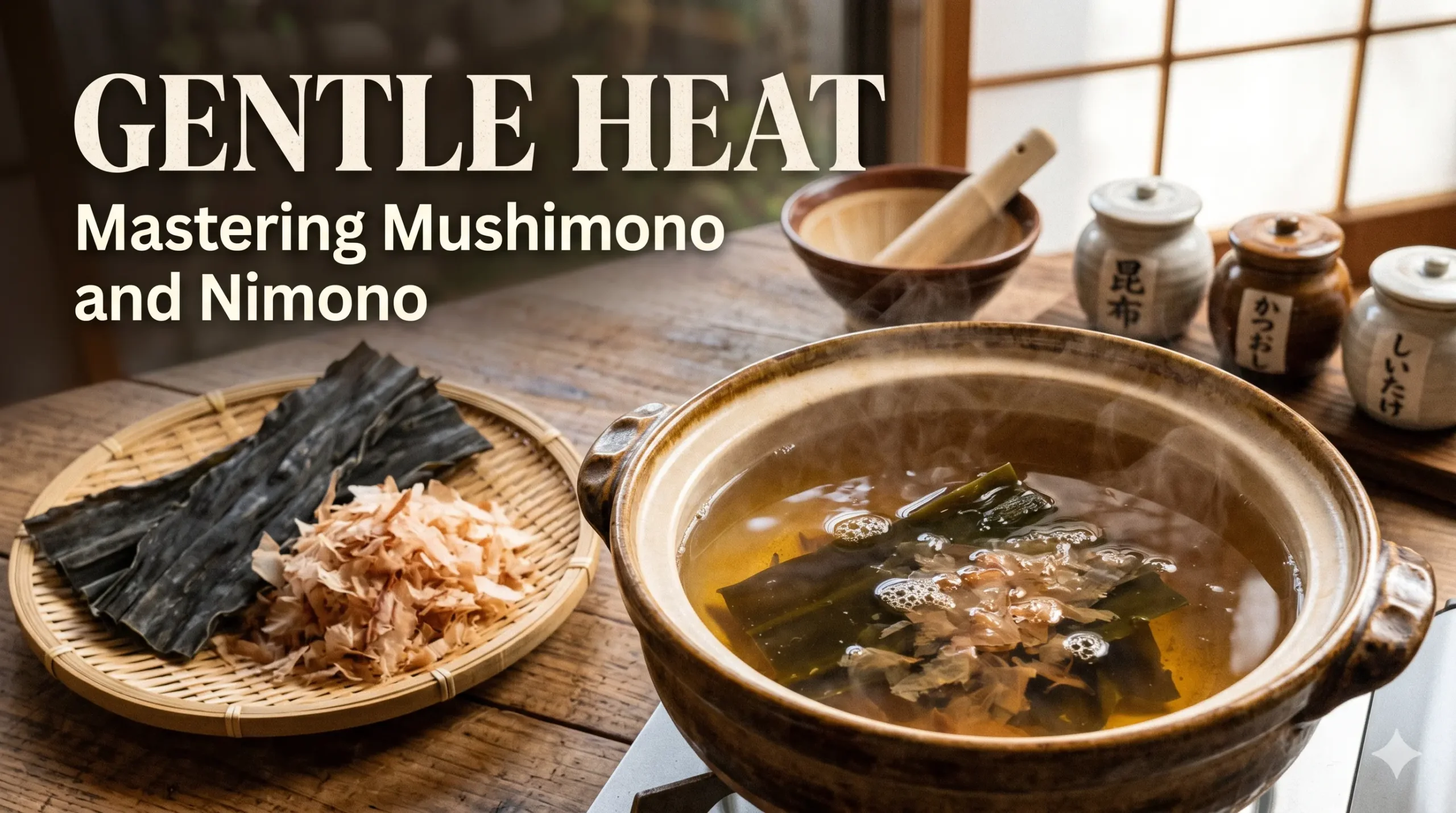
In the high-heat, high-speed world of modern cooking, the Japanese techniques of Mushimono (steamed dishes) and Nimono (simmered dishes) represent a sophisticated turn toward patience and temperature control. While grilling and frying focus on the “Maillard reaction” and caramelization, steaming and simmering focus on thermal equilibrium and the preservation of cellular structure.
To master these techniques, a chef must transition from a “warrior” mentality to that of a “nurturer.” This article explores the delicate science of Chawanmushi and the strategic layering of flavors in traditional Nimono stews.
Part 1: Mushimono – The Science of the “No-Bubble” Custard
The pinnacle of Japanese steaming is Chawanmushi, a savory egg custard. Its success depends entirely on managing the coagulation of egg proteins without allowing them to toughen or “pock-mark” with air bubbles.
The Ratio of Silk
A professional Chawanmushi should have the consistency of silk, barely holding its shape. This is achieved through a specific dilution ratio:
- The Formula: 1 part egg to 3 parts Dashi (by volume).
- The Physics of Dilution: The proteins in the egg are diluted by the Dashi, which raises the coagulation temperature. This creates a wider window for the eggs to set into a smooth gel rather than a rubbery solid.
The Temperature Trap
Egg proteins begin to coagulate at roughly $60^{\circ}C$ and become firm at $70^{\circ}C$. However, water boils at $100^{\circ}C$. If you steam at a full, aggressive boil, the custard will reach the boiling point internally, causing the water trapped in the protein web to turn into steam. This creates the “honeycomb” holes often seen in amateur custards.
- The Technical Solution: Keep the steamer lid slightly ajar with a chopstick. This allows excess steam to escape, maintaining the internal temperature of the steamer at a steady $85^{\circ}C$ to $90^{\circ}C$.
Part 2: Nimono – The Architecture of Simmering
Nimono refers to dishes simmered in a seasoned liquid, often a combination of Dashi, soy sauce, mirin, and sake. This is the ultimate “home-cooked” style of Japan, but it requires a strategic understanding of ingredient density.
The “Otoshibuta” (Drop Lid) Technique
A unique feature of Japanese simmering is the use of an Otoshibuta. This is a lid that is smaller than the pot, resting directly on top of the ingredients.
- Thermal Circulation: The drop lid forces the simmering liquid to circulate up and over the ingredients, ensuring even flavor distribution without the need for stirring (which would break the delicate vegetables).
- Concentration: It prevents the liquid from evaporating too quickly, allowing the flavors to concentrate slowly and penetrate deep into the fibers of the food.
The Order of Seasoning: “Sa-Si-Su-Se-So”
In Nimono, the order in which you add ingredients is vital for molecular absorption. Japanese chefs follow the mnemonic Sa-Si-Su-Se-So, based on the Japanese alphabet:
- Sa (Sato): Sugar. Sugar molecules are large and slow to penetrate. They must go in first to soften the fibers.
- Si (Shio): Salt. Salt draws out moisture and should follow sugar.
- Su (Su): Vinegar. (Used primarily in specific braises).
- Se (Shoyu): Soy Sauce. Added late to preserve its volatile aromatic compounds.
- So (Miso): Miso. Added last and never boiled, as high heat destroys its delicate fermented flavor.
Part 3: Mentori – The “Edge-Rounding” Technique
When simmering root vegetables like Daikon (radish) or Kabocha (squash), a professional chef performs Mentori. This involves using a peeler or knife to slightly round off the sharp edges of each cut piece.
- The Reason: In a simmering pot, the sharp edges of vegetables are the first to break down and turn into “mush” as they rub against each other. By rounding the edges, the chef ensures the vegetables maintain a clean, architectural shape even after long simmering.
Conclusion: The Quiet Strength of Water
Mushimono and Nimono teach us that heat does not always need to be aggressive to be effective. Through the gentle medium of steam and seasoned water, we can transform tough root vegetables into tender morsels and liquid eggs into silk. These techniques are the quiet heartbeat of the Japanese kitchen, proving that the most profound flavors are often those that are coaxed, not forced.