
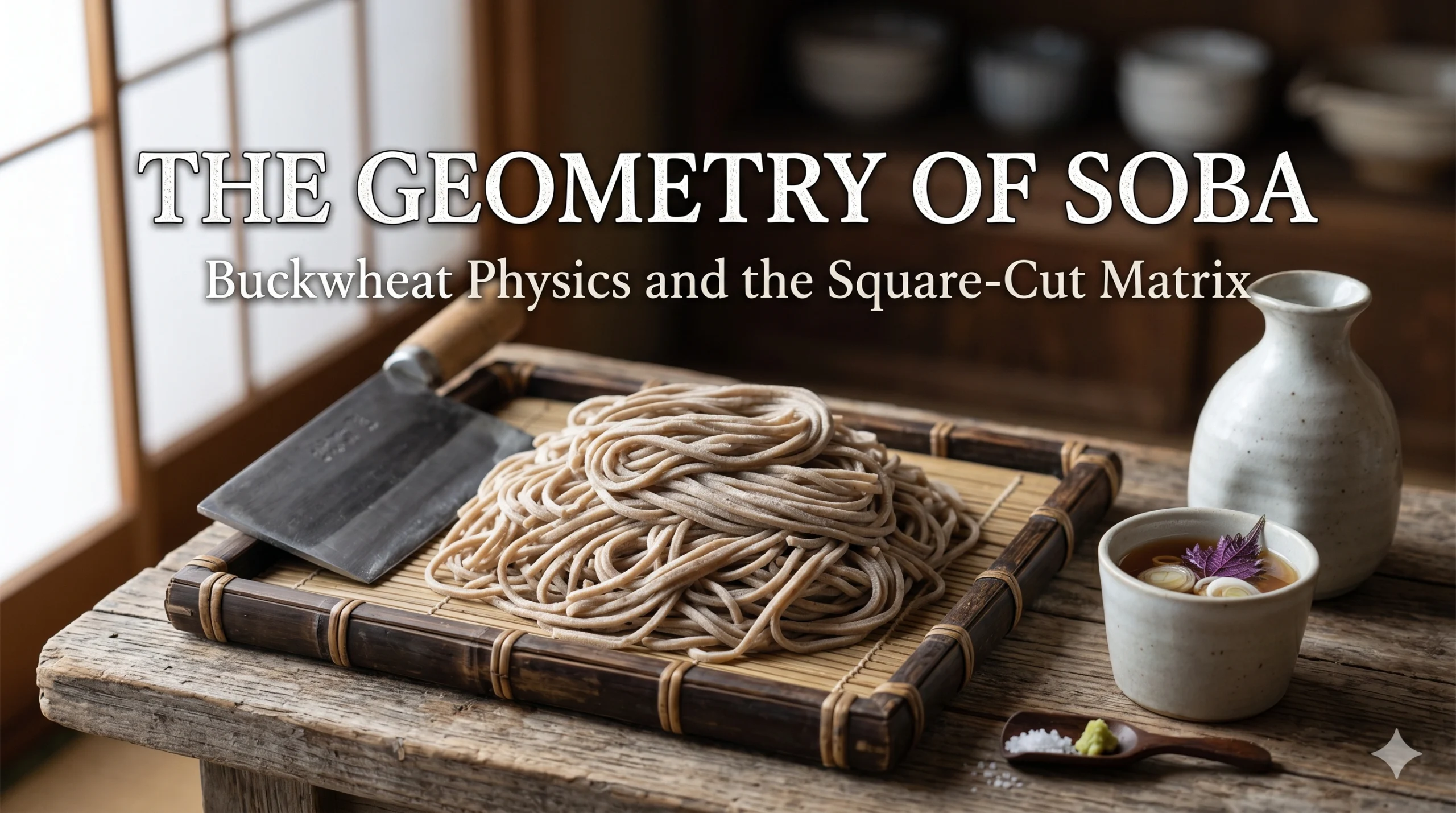
To conclude our technical journey through the fundamental starch and protein systems of Japan, we must analyze Soba (buckwheat noodles). While ramen relies on alkaline chemistry (Kansui) to create a springy texture, and udon relies on intensive gluten development, Soba is technically a study in particle geometry and physical density. Soba, specifically Ni-Hachi (80% buckwheat, 20% wheat), represents the ultimate structural compromise between a non-gluten flour and a required matrix.
To master Soba, one must move beyond “kneading” and toward the engineering of a non-cohesive particle stack.
Part 1: Buckwheat Physics – The Gluten-Free Crisis
The core technical challenge of Soba is that buckwheat is not wheat. It lacks the necessary gluten proteins (glutenin and gliadin) required to form the elastic, cohesive structure of a noodle. Pure buckwheat flour (Jyu-wari Soba) is essentially a powder that dissolves in water.
- The Protein Difference: Wheat contains high amounts of glutenin (providing elasticity) and gliadin (providing extensibility). Buckwheat proteins, conversely, are primarily globulins and albumins, which provide no cohesive structure when mixed with water.
- The Binder System: This is why most professional Soba is Ni-Hachi Soba (20% wheat binder). The chef is technically creating a standard wheat dough matrix ($20\%$), which then must physical capture and support a non-cohesive buckwheat particulate load ($80\%$). It is a particle suspension, not a gluten chain.
Part 2: Uchi – The Geometry of Particle Stacking
Because Soba has very little elasticity, standard dough manipulation fails. If you stretch Soba, it breaks. Instead, the Soba-ya uses geometry to achieve thickness.
The Standard Geometry:
- Maru-me (Circle): The dough is first worked into a perfect, dense sphere to equalize density.
- Kaku-出し (Square-Out): The dough is not rolled thin; it is physically flattened into a perfect, thin square by folding and applying downward pressure with a Menbo (rolling pin). The Soba chef maintains this square shape with perfect, 90-degree corners. Why?
- Physical Folding: To achieve thickness, the thin square sheet is folded into layers. These layers are not compressed; they are physically stacked. When the final cutting occurs, the thickness of the noodle is determined purely by the physical thickness of the stacked layer, not by any physical stretching.
Part 3: Kiri – The Perfect Cross-Section
The final technical act of Soba is the Kiri (cutting). This is the reason for the square geometry of the initial sheet.
- The Soba-Kiri Cleaver: The Soba knife is unique: a massive, heavy, dead-straight square-faced cleaver. The weight of the knife itself provides the cutting power.
- The Wooden Guide (Koma-ita): The chef uses a wooden board as a precision cutting guide. Each cut is perfectly straight.
- The Perfect Square Cross-Section: By cutting a perfectly flat, stacked sheet with a perfectly straight, heavy blade, the resulting noodle has a precise 1mm x 1mm square cross-section. This geometry ensures that every noodle has the exact same surface area, allowing for uniform cooking times (usually 60 seconds) and, crucially, a flawless Tsuyu (dipping sauce) adhesion. If the noodle cross-section were round or uneven, the Tsuyu would slip off; the square edge provides maximum surface tension.
Conclusion: The Final Starch Integrity
Soba is the triumph of geometry over material failure. By recognizing that buckwheat has no internal cohesive structure, the Japanese system utilizes the strict physical stack, the square sheet, and the precision cleaver to create an engineered noodle. It is the final proof that in Washoku, if the chemistry cannot provide the desired result, the geometry will.