
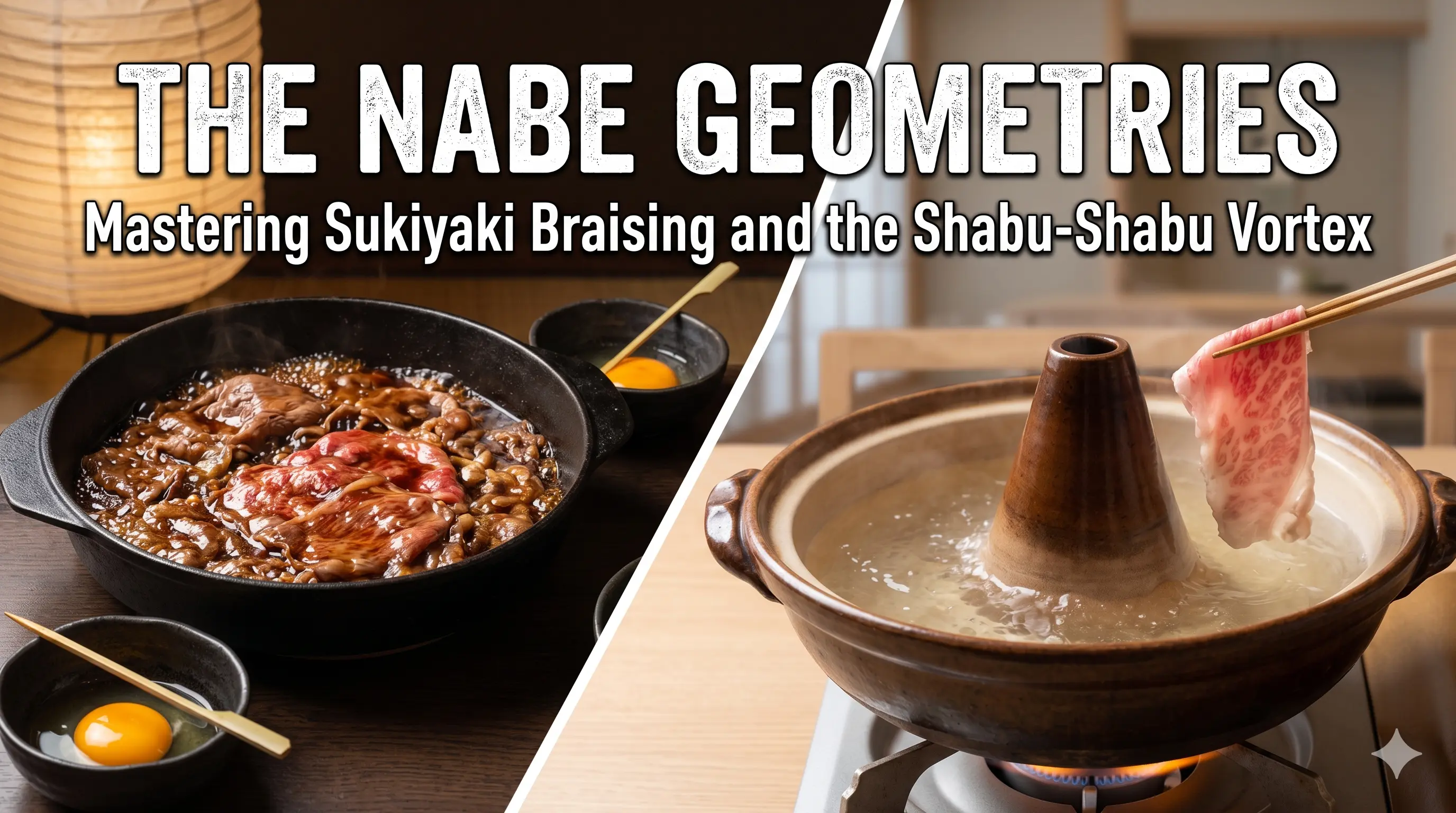
In our previous discussions on Washoku, we have focused on the individual master (the sushi chef, the unagi-ya). However, in the Japanese culinary landscape, the most technical group-dining experience is the Nabemono (hot-pot). This article analyzes the two most distinct and technical forms: Sukiyaki and Shabu-Shabu.
To master these dishes, one must move away from the simple concept of a “stew.” Sukiyaki is a technique of caramelized braising, while Shabu-Shabu is a form of high-precision biological flash-steaming. Their geometries, thermal dynamics, and flavor objectives are fundamentally opposed.
Part 1: Sukiyaki – The Geometry of the Skillet and Caramelized Fat
Sukiyaki is an Osaka-style dish that relies on a specific thermal sequence: sear, braise, and coat. It is defined by its deep, sweet-savory intensity and its use of a skillet, not a deep pot.
1. The Shallow Braise (Nitsume)
- The Gear: A wide, heavy cast-iron skillet is used. Why a skillet? Sukiyaki relies on the Maillard reaction (browning) and caramelization before any liquid is added.
- The Sequence: The first ingredient into the hot pan is not stock; it is a chunk of beef suet (fat). The high-grade beef (A5 Wagyu) is then seared directly on the hot iron, caramelizing the natural sugars and fats. Only then is the Warishita (a concentrated soy-sugar-mirin “mother sauce”) poured over the meat.
- The Technical Goal: This is not a soup. The liquid in Sukiyaki is a highly concentrated reduction that braises the ingredients, ensuring that the beef and vegetables absorb the maximum amount of flavor and achieve a magnificent, sticky-caramelized sheen.
2. The Final Buffer (Biological Safety)
Sukiyaki is famous for the side-dip of raw egg. This serves two essential technical purposes:
- Aromatic Buffering: The raw egg yolk provides a silky, alkaline buffer that cuts through the extreme sugar and salt intensity of the Warishita, preventing sensory overload.
- Pasteurization (Safe Consumption): While Western readers may be concerned about raw eggs, Japanese food safety standards include rigid sterilization and an efficient “wash and coat” system. When the piping-hot ($90^{\circ}C+$) beef is dipped into the cold egg, the heat of the beef instantly “flashes” the protein on the egg, pasteurizing the small amount that coats the meat.
Part 2: Shabu-Shabu – The Physics of “Swish-Swish”
Shabu-Shabu (named for the sound of the “swish-swish” motion) is Sukiyaki’s technical opposite. Where Sukiyaki is dark, caramelized, and braised, Shabu-Shabu is clear, instantaneous, and delicate.
1. The Geometry of the Shabu Pot (The Vortex)
The Shabu-Shabu pot (Dona-be) is unique:
- The Chimney: It is not a flat-bottomed pot. It features a conical chimney in the center, designed to be heated by an internal fire-cone.
- The Thermal Convection: This chimney creates powerful internal convection currents, keeping the Kombu Dashi (clear kelp stock) at a rolling, stable boil ($100^{\circ}C$) only on the outer edge. The center remains relatively calm.
2. The Flash-Cook (瞬・生物学 – Shun Seibutsugaku)
- The Action: The key is speed. A thin slice of A5 Wagyu is lowered into the boiling perimeter vortex. It is not dropped in.
- The Biological Logic: The chef applies a very brief, rapid “swish-swish” motion (3–5 seconds).
- The Technical Goal: This flash-cooking instantaneously renders the surface fats, creating a luxurious emulsion. However, because the cooking time is so short, the internal structure of the meat remains rare. This preserves the melt-in-the-mouth texture of high-grade beef while ensuring the surface is sanitized. Shabu-Shabu is a technical compromise between biological safety and the ultimate flavor of raw marbling.
Conclusion: The Opposing Stances of NABE
Sukiyaki and Shabu-Shabu demonstrate how geometry and heat management define a dining experience. One is a shallow skillet for concentrated, slow-caramelized braising. The other is a deep, vortex pot for clear, rapid, biological flash-steaming. They represent the two technical poles of Japanese communal dining: a dish for immediate gratification through clear purity (Shabu-Shabu) and one for complex depth through caramelized concentration (Sukiyaki).