
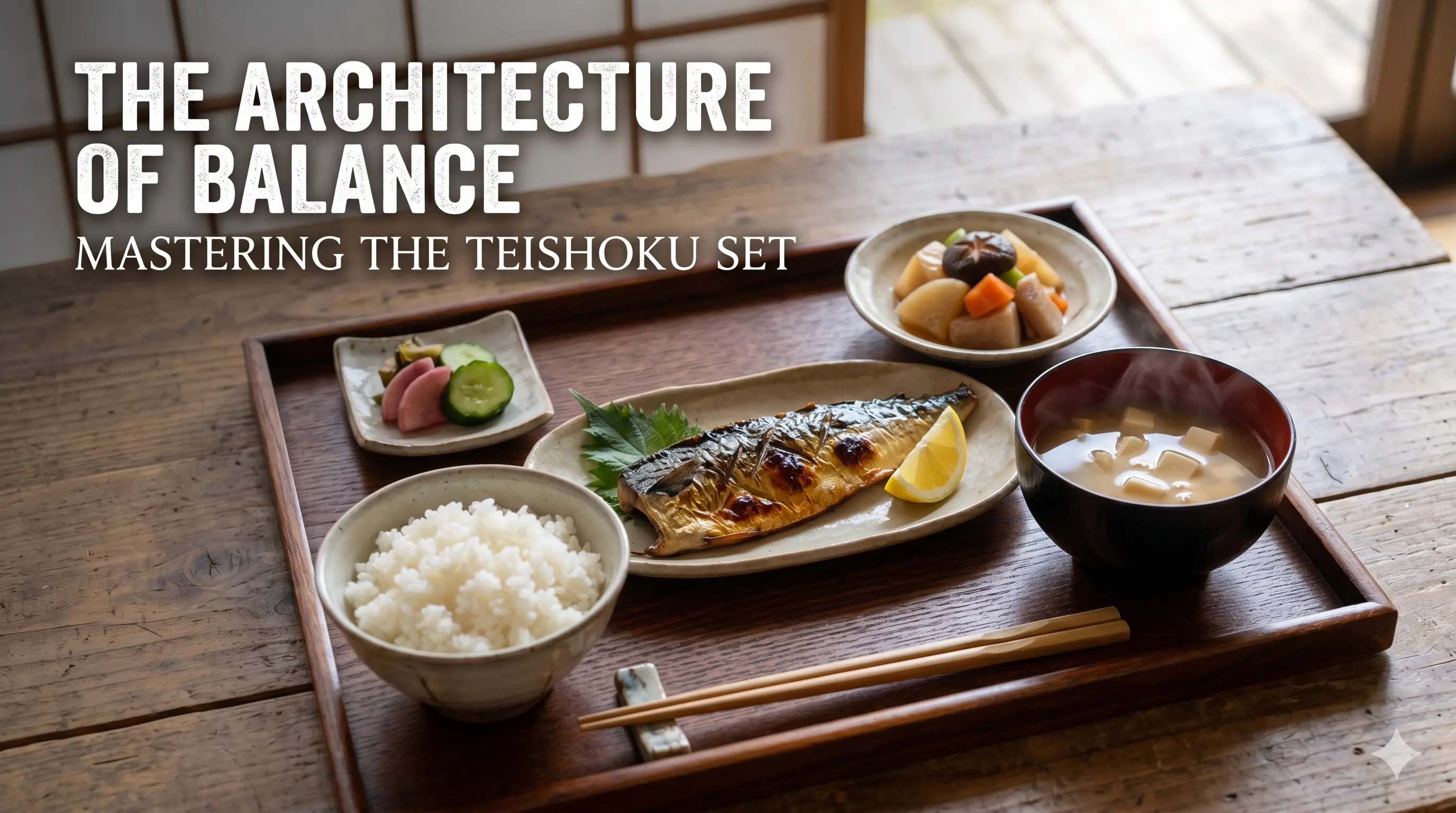
While individual techniques like grilling or simmering are essential, the ultimate expression of daily Japanese life is Teishoku (set meals). Unlike a multi-course Western meal that progresses linearly, Teishoku is an architectural arrangement of dishes served simultaneously. Its design is governed by the ancient philosophy of Ichiju-Sansai (one soup, three sides), a system engineered to provide a perfect balance of macro-nutrients, flavors, and digestive enzymes.
To master Teishoku, one must understand that the meal is a single ecosystem. This article breaks down the structural rules that define a high-quality Japanese set meal.
Part 1: Ichiju-Sansai – The Rule of One Soup, Three Sides
The technical blueprint of Teishoku is consistent. It consists of a staple (rice), a liquid (soup), and three specific categories of side dishes:
1. The Staple: Gohan (Rice)
The rice is the anchor. In a Teishoku set, the rice is always served on the front-left. It provides the neutral base that resets the palate between the different flavors of the side dishes.
2. The Liquid: Shirumono (Soup)
Typically Miso soup, served on the front-right. Its role is two-fold: hydration and the introduction of fermented enzymes to aid digestion.
3. The Protagonist: Shusai (Main Dish)
This is usually a protein—grilled fish (Yakimono), breaded pork (Tonkatsu), or simmered beef. It provides the majority of the meal’s fat and protein.
4. The Supporting Cast: Fukusai and Fukufukusai (Side Dishes)
- Fukusai: A substantial vegetable side, often simmered (Nimono).
- Fukufukusai: A small, punchy side, like a vinegar-based salad (Sunomono) or a cold tofu dish (Hiyayakko).
Part 2: Ma-ai – The Art of Flavor Spacing
In Teishoku, the chef must manage the “flavor spacing” between dishes. This involves a calculated variety of cooking methods and temperatures to prevent sensory fatigue.
- Temperature Contrast: A high-quality set includes at least one steaming hot dish (the soup), one room-temperature dish (the simmered vegetables), and one cold dish (the pickles or salad).
- The Five Tastes: The set must hit Sweet (mirin-based braises), Sour (pickles), Salty (soy sauce/miso), Bitter (seasonal greens), and Umami (dashi). If two dishes share the same dominant flavor profile, the Teishoku is considered poorly engineered.
Part 3: Triangle Eating (Sankaku-tabe)
Teishoku is designed for a specific style of consumption called Sankaku-tabe (Triangle Eating). The diner takes a bite of rice, then a bite of the main dish, then a sip of soup, and so on.
Why this matters for the Chef:
Because the dishes are eaten together, the seasoning of the side dishes must be slightly more intense than if they were eaten alone. The rice acts as a “buffer,” so the Nimono or Yakimono must have enough salinity to flavor the neutral rice during the chewing process. This interaction is where the true “seasoning” of the meal happens—not in the pot, but in the diner’s mouth.
Conclusion: Harmony Through Diversity
Teishoku is a testament to the Japanese belief that health and satisfaction come from variety, not volume. By adhering to the Ichiju-Sansai structure, a chef ensures that the meal is a complete nutritional and sensory experience. It is the ultimate example of how logic and tradition can engineer a meal that satisfies the body as much as the palate.