
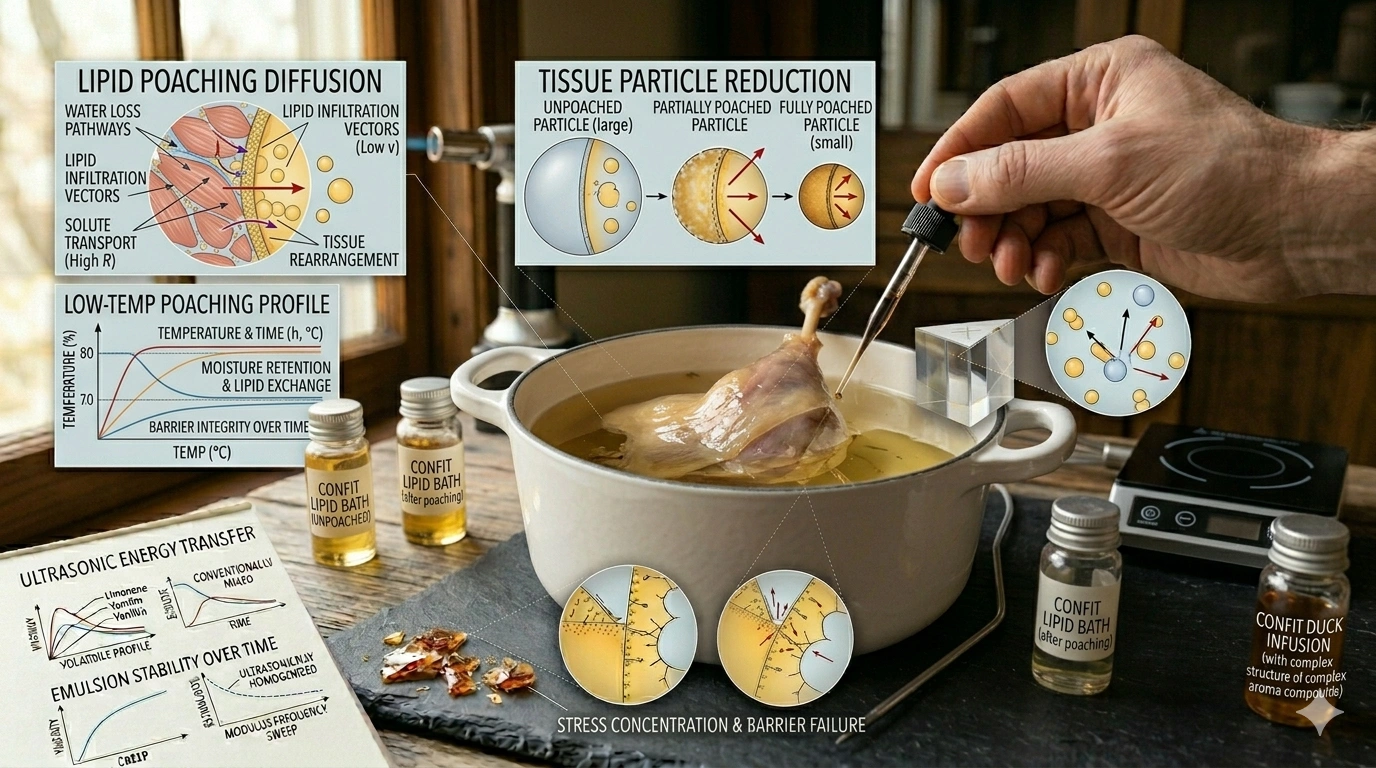
From the violent turbulence of the deep fryer, we descend into the steady, silent thermal environment of the Confit. Originally a preservation technique from southwest France, the modern confit is a masterclass in low-temperature protein denaturization and lipid-based moisture retention. It involves poaching an ingredient—traditionally duck leg—completely submerged in fat at temperatures well below the boiling point of water.
To master the Confit, one must understand the relationship between hydrostatic lipid pressure and collagen-to-gelatin conversion.
Part 1: The Fat Barrier – Engineering the Moisture Lock
The primary technical misconception is that the meat “absorbs” the fat. In reality, the fat acts as a thermal regulator and an evaporation shield.
- Hydrophobic Containment: Because oil and water do not mix, the submerged environment prevents the internal juices of the meat from evaporating into the air.
- The Thermal Buffer: Fat has a lower specific heat capacity than water but provides a more stable, even heat distribution than air. By maintaining the fat between $75^{\circ}C$ and $90^{\circ}C$, the chef ensures the meat never reaches a simmer, preventing the aggressive contraction of muscle fibers that results in “toughness.”
Part 2: Collagen Conversion – The Kinetic Time Variable
The “melting” texture of a confit is the result of a long-form chemical reaction: the transformation of connective tissue into silk.
- The Gelatin Shift: Tougher cuts of meat are high in collagen, a triple-helix protein that is incredibly strong. At sustained temperatures above $70^{\circ}C$, these helices begin to unwind and dissolve into gelatin.
- Intramuscular Lubrication: Because this happens in a fat-rich environment with zero evaporation, the resulting gelatin stays trapped within the muscle fibers. This creates a perceived “succulence” that is actually a combination of liquid gelatin and rendered intramuscular fat.
Part 3: The Preservation Paradox – Fat as an Airtight Seal
Historically, the “Confit” (from the French confire, meaning “to preserve”) was a method of survival.
- The Exclusion of Oxygen: Once the cooking is complete and the fat cools, it solidifies into a dense, white plug.
- Anaerobic Engineering: This layer creates a total anaerobic (oxygen-free) environment. By storing the cooked meat completely submerged in its own rendered fat, the chef prevents the growth of aerobic bacteria, allowing the meat to be stored safely for months in a cool environment.
Conclusion: The Mastery of Patience
The Confit proves that intensity is not the only path to transformation. By leveraging the hydrophobic properties of lipids and the slow kinetics of collagen breakdown, the chef creates a texture that is both structurally intact and effortlessly tender. It is the physics of the “Slow Glide”—a triumph of steady-state thermodynamics.