
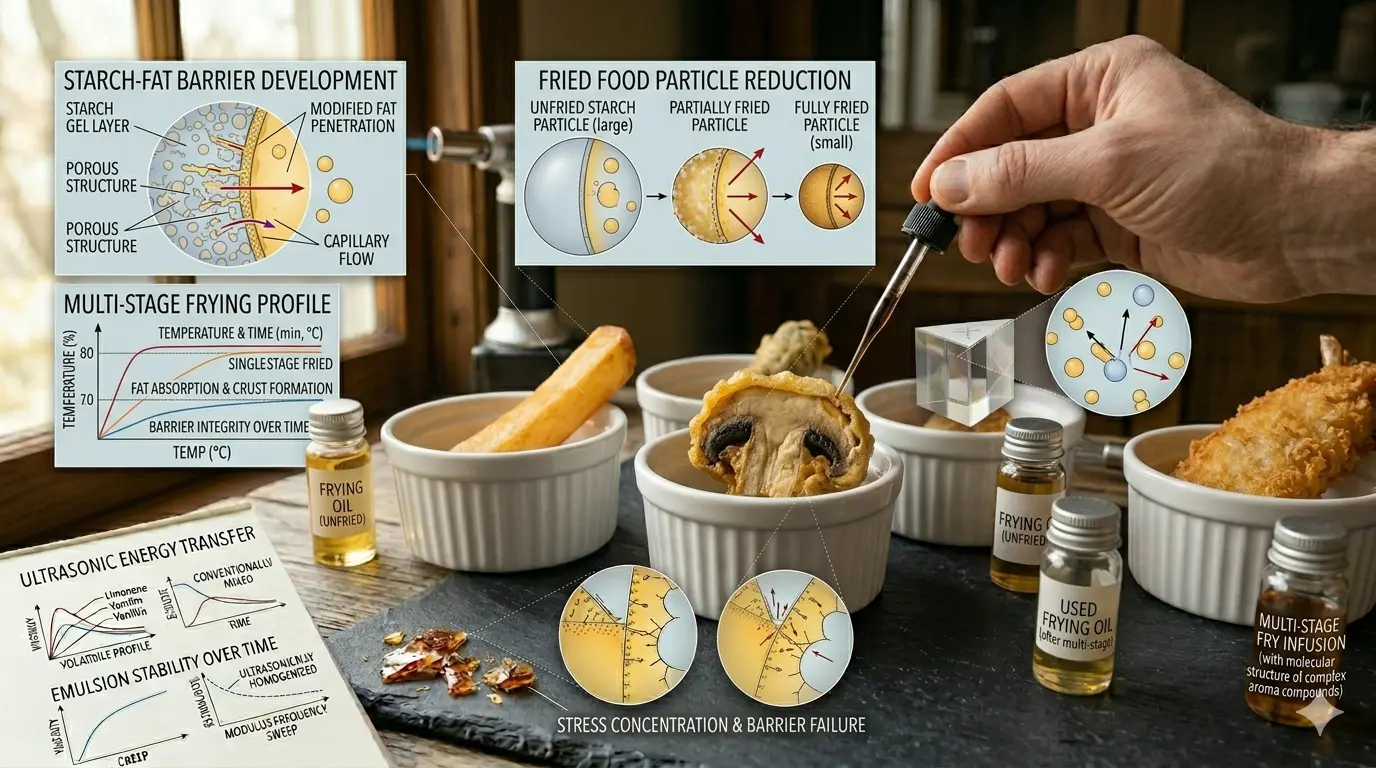
We move from the radiative heat of the oven to the conductive immersion of the deep fryer. While deep frying is often viewed as a simple method of high-heat cooking, the “perfect fry” (specifically the Triple-Cooked Chip, popularized by Heston Blumenthal) is a sophisticated exercise in moisture-to-void replacement and starch retrogradation.
To master the Multi-Stage Deep Fry, one must understand the relationship between vapor pressure crust formation and lipid migration.
Part 1: The First Cook – Starch Gelatinization and Fissure Creation
The goal of the initial stage (often a simmer in water) is not to cook the potato, but to prepare its surface architecture.
- The Softening of the Matrix: Simmering the potato until it is nearly falling apart creates microscopic cracks and fissures on the surface. These fissures increase the surface area, which will eventually become the “crunch” zone.
- Pectin Breakdown: Controlled boiling breaks down the cell-wall pectins, ensuring the interior remains fluffy and “mashed” rather than waxy.
Part 2: Retrogradation – The Cooling Phas
The most overlooked technical step is the cooling (or freezing) period between cooks. This is an act of molecular reorganization.
- Starch Retrogradation: As the cooked potato cools, the gelatinized starch molecules begin to re-associate into a more ordered, crystalline structure. This “toughens” the fissures created in the first cook.
- Moisture Extraction: Placing the potatoes in a freezer or vacuum chamber removes surface moisture. This is critical because any water on the surface will interfere with the “flash” of the second cook.
Part 3: The Second and Third Cook – The Crust Engineering
The frying process is a battle between escaping steam and entering fat.
- The Blanching Fry ($130^{\circ}C$): This cook creates a “skin.” The heat dehydrates the outer layer, forming a starch-protein barrier. It isn’t hot enough to brown the potato (Maillard reaction), but it is hot enough to set the structure.
- The Final Crisp ($180^{\circ}C$): In the final stage, the remaining moisture in the surface fissures flashes into steam. As the steam exits, it leaves behind microscopic voids. The hot oil instantly fills these voids, but the internal “retrograded” starch prevents the oil from penetrating into the fluffy core.
- The Result: A glass-like, rigid exterior that is structurally sound enough to stay crisp for minutes, protecting a soft, steamed interior.Conclusion: The Barrier of Void
The perfect deep fry proves that crunch is a function of geometry. By creating surface fissures, cooling to reorganize starches, and using high-heat lipids to replace escaping steam, the chef engineers a hydrophobic barrier that is the pinnacle of textural contrast. It is the physics of the “Starch-Glass” shield.