
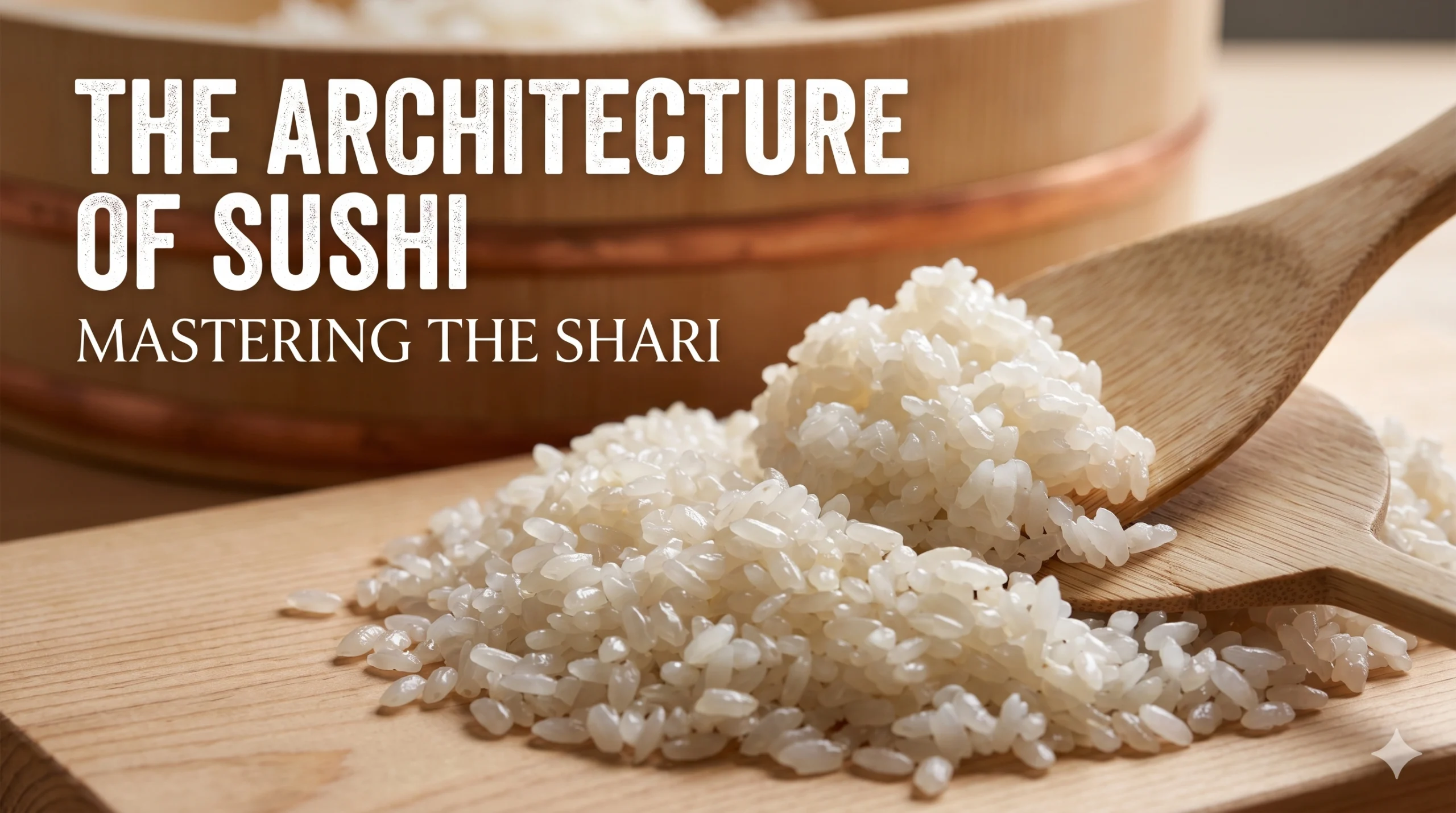
When most people think of sushi, their minds immediately go to the Neta—the shimmering slice of raw tuna, the buttery salmon, or the delicate scallop resting on top. However, in the 1,000-year evolution of Japanese cuisine, the word “sushi” actually refers to the rice. Su means vinegar, and Shi (derived from meshi) means rice. The fish is merely the garnish; the rice is the soul.
Creating high-quality sushi rice is not a simple task of boiling grains. It is a complex exercise in physics, chemistry, and structural architecture. This article provides a deep dive into the technical mastery required to create the perfect Shari (sushi rice).
The Molecular Foundation: Choosing the Grai
To understand sushi, you must understand starch. Unlike long-grain varieties like Basmati or Jasmine, sushi requires Short-Grain Japanese Rice (such as Koshihikari or Akitakomachi).
The secret lies in the ratio of two starches: Amylose and Amylopectin.
- Long-grain rice is high in Amylose, which keeps grains separate and fluffy.
- Short-grain rice is packed with Amylopectin, which provides the “sticky” characteristic when cooked.
For sushi, the goal is “sticky but distinct.” The grains must adhere to one another to hold a shape, but when the sushi hits the tongue, the grains should instantly separate. If the rice is a solid, gummy mass, it is a failure of physics.
Part 1: The Ritual of Preparation (The “Polishing”)
Before a single drop of water is boiled, the rice must undergo a physical transformation.
1. Polishing (Togi)
Modern rice still carries a layer of residual bran and excess starch powder. If left on, this creates a “muddy” flavor and a slimy texture.
- The Technique: Place the dry rice in a bowl and use the heel of your hand to gently “knead” the grains in a circular motion. Add a splash of water, swish, and drain. Repeat this 3 to 5 times until the water runs almost perfectly clear. You are essentially “polishing” the surface of each grain to ensure a clean, pearl-like finish.
2. The Hydration Phase (Kashi)
After polishing, the rice must rest in cold water. This allows moisture to penetrate the hard core of the grain.
- Timing: Soak for 30 minutes in the summer and 60 minutes in the winter.
- The Result: Proper hydration ensures that the grain gelatinizes evenly from the center outward. Without this, you end up with rice that is mushy on the outside but has a hard, “chalky” center.
Part 2: The Heat and Pressure (Nitsume)
Cooking sushi rice is about managing steam pressure.
- The Ratio: Use a strict 1:1.1 ratio (rice to water by volume). We use less water than standard recipes because we will be adding liquid vinegar later.
- The Seal: Whether using a heavy-bottomed pot or a high-end induction rice cooker, the lid must never be lifted. Lifting the lid releases the specific pressure required to force water into the starch molecules.
Part 3: The Chemistry of Seasoning (Su-Awase)
Once the rice is cooked, the clock starts ticking. The seasoning must be applied while the rice is at its maximum heat to allow for chemical absorption.
1. The Vinegar Profile
Traditional sushi vinegar is a balance of Rice Vinegar, Sugar, and Sea Salt. For a professional result, the ratio is:
- 80ml Rice Vinegar
- 30g Sugar
- 10g Salt (Adjusted for 3 cups of uncooked rice)
2. The Hangiri (The Wooden Cradle)
The rice should be transferred to a Hangiri, a wide, flat-bottomed tub made of Japanese Cypress (Sawara). Wood is essential because it absorbs excess steam. If you use a plastic or metal bowl, the steam condenses into water, making the bottom layer of rice soggy.
3. Shari-Kiri: The Slicing Motion
This is the most technical part of the process. You do not “stir” the vinegar in.
- Slicing: Using a wooden paddle (shamoji), use a horizontal “cutting” motion to break up the rice clumps. This ensures every grain is coated in vinegar without crushing the delicate structure.
- Fanning (Uchiwa): As you slice, use a hand fan to rapidly cool the rice. This rapid cooling creates a glossy lacquer on the outside of each grain. This shine is the hallmark of high-quality sushi rice.
Part 4: The Architecture of the Final Form
The final serving temperature must be body temperature (approx. 37°C).
Nigiri Architecture
When a chef presses a Nigiri, they are creating a “bridge.” The bottom should be firm enough to be picked up with fingers, but the center should contain tiny air pockets. When you bite into it, these air pockets allow the flavors of the vinegar and the fish to aerate and expand in the mouth.
Maki (Roll) Architecture
In a roll, the rice is a structural wall. It should be spread only 3–4 grains thick. Any thicker, and the starch will overpower the delicate flavor of the fish and vegetables.
Conclusion
The architecture of sushi is built from the bottom up. A master chef spends the first three years of their apprenticeship doing nothing but washing and cooking rice. They understand that while the fish is a gift from the sea, the rice is a testament to human precision. Until the rice is perfect, the sushi does not exist.