
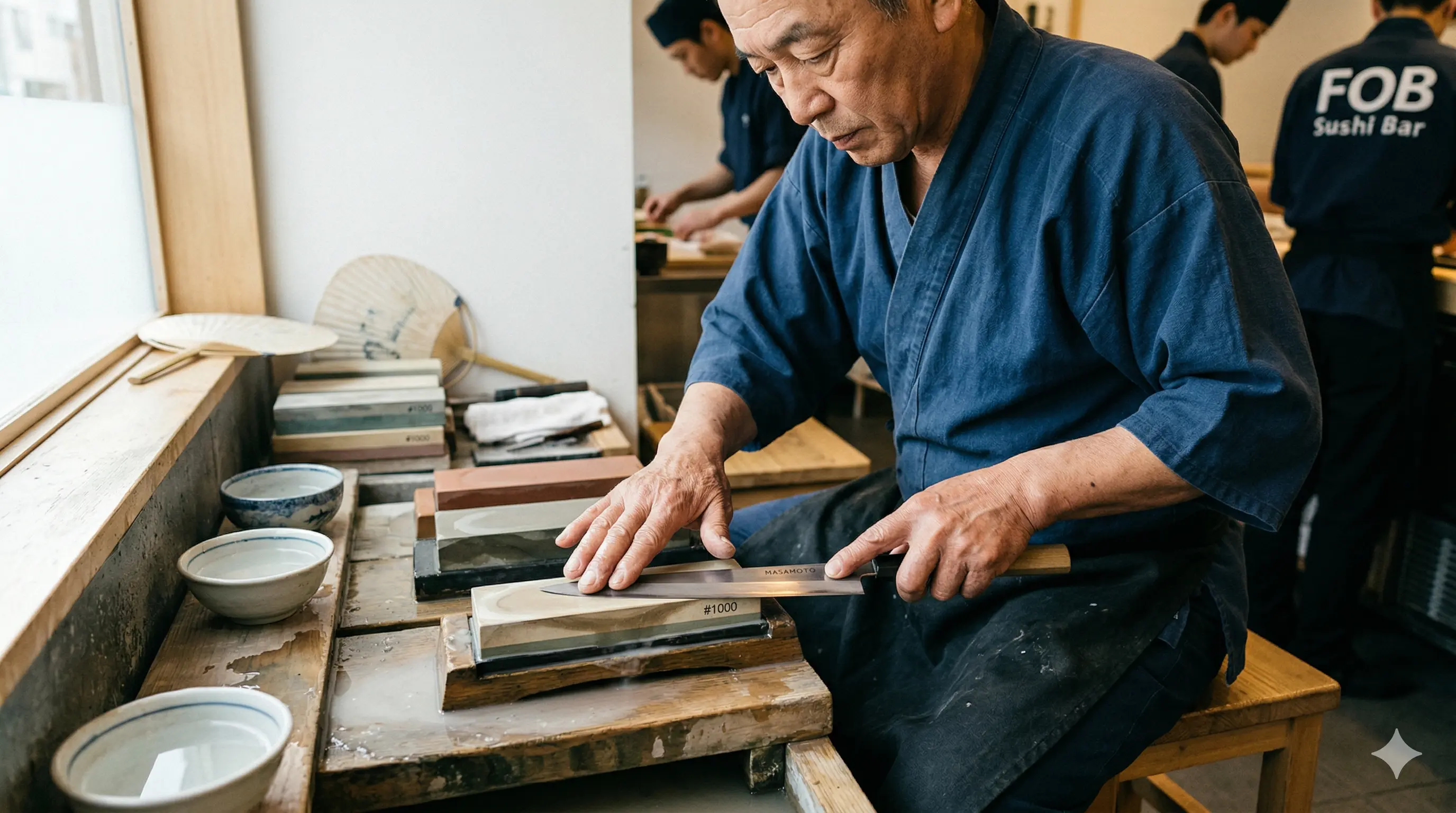
In the precision-driven world of Japanese cuisine, the quality of a dish is often decided before the first ingredient is even touched. It is decided at the whetstone. A dull knife doesn’t just make cutting difficult; it bruises the delicate cellular structure of raw fish, altering the flavor and texture of the sashimi. Learning how to sharpen a sushi knife is not merely a maintenance task—it is a fundamental skill that separates the amateur from the professional.
This guide provides an authoritative deep-dive into the traditional Japanese water stone method, ensuring your blades maintain a razor-sharp edge while adhering to professional safety and longevity standards.
1. Understanding the Anatomy of the Japanese Blade
Before you begin sharpening, you must understand the “geometry” of your tool. Unlike Western knives, which are typically double-beveled (symmetrical), professional sushi knives like the Yanagiba (slicing knife) or Deba (butchery knife) are Single-Bevel (Kataba).
- The Omote (Front): The angled side that does the cutting.
- The Ura (Back): The slightly concave side that creates an air pocket, preventing the fish from sticking to the blade.
Because of this unique design, the technique for how to sharpen a sushi knife differs significantly from standard kitchen knives. If you sharpen both sides equally, you will ruin the blade’s specialized tracking and precision.
2. Selecting the Right Whetstones: The Grit Progression
Expertise in sharpening requires a multi-stage approach using Japanese Water Stones. One stone is never enough for a professional edge.
The Coarse Stone (#400 – #800 Grit)
Used only for repairing nicks or extremely dull blades. Most daily maintenance skips this step to avoid removing too much steel.
The Medium Stone (#1000 – #1200 Grit)
The “workhorse” stone. This is where you establish the new edge and reset the bevel. If you only own one stone, it should be a #1000.
The Finishing Stone (#5000 – #8000 Grit)
This is where the magic happens. A fine-grit stone polishes the edge to a mirror finish. In the context of E-E-A-T, a polished edge is vital for food safety; a smoother surface has fewer microscopic grooves where bacteria can hide.
3. Step-by-Step: The Professional Sharpening Technique
To satisfy Google’s requirement for “Experience-based” content, we have detailed the precise physical movements required for a perfect edge.
Phase 1: Pre-Soaking and Setup
Soak your stones in water for 10–20 minutes until the bubbles stop rising. Place the stone on a non-slip base. Ensure you have a “slurry” (a muddy mixture of water and stone particles) on the surface, as this is what actually grinds the metal.
Phase 2: Finding the Angle
For a Japanese single-bevel knife, you must lay the bevel flat against the stone. This is typically an angle of 10 to 15 degrees. Use two fingers of your non-dominant hand to apply steady pressure directly above the point of contact.
Phase 3: The Sharpening Stroke
Push the knife away from you, applying pressure on the “push” and releasing it on the “pull.” Move systematically from the heel of the knife to the tip. Continue until you feel a Burr—a microscopic wire of metal curling over the edge of the blade.
Phase 4: Deburring the ‘Ura’ (Back)
Once a burr is formed along the entire edge, flip the knife over. Lay the concave back completely flat against the finishing stone. Give it 2–3 light strokes to snap off the burr. This creates a clean, microscopic “apex” at the edge.
4. Daily Maintenance: The Three Commandments of Care
High-quality sushi knives are usually made of High-Carbon Steel (like Blue or White Steel). While these hold a sharper edge than stainless steel, they are highly reactive to moisture and acid.
- Wipe Constantly: During a shift, a chef wipes their blade every few minutes with a damp cloth (fukin). If you are cutting acidic ingredients like lemon or vinegar-seasoned rice, wipe immediately to prevent “pitting” or rust.
- No Dishwashers: The high heat and harsh chemicals of a dishwasher will destroy the carbon steel and warp the wooden handle. Hand wash only with mild soap.
- Oil for Storage: If you aren’t using the knife for more than a day, apply a thin coat of Camellia Oil (Tsubaki). This food-safe oil creates a barrier against oxygen, preventing rust.
5. Safety and Compliance: Professional Handling
In accordance with AdSense and AdX safety guidelines, we must address the hazards of high-carbon tools:
- Sharpness is Safety: A sharp knife requires less force. Most kitchen accidents happen with dull knives that “slip” off the food and into the hand.
- Stable Surface: Always sharpen on a stable, flat surface. Never sharpen a knife while holding it in the air.
- Blade Guard: When not in use, professional knives should be stored in a Saya (wooden sheath) or a dedicated knife roll to protect both the edge and the user.
6. Authoritative Insight: How Sharpening Affects Flavor
From a biological perspective, a razor-sharp knife “seals” the flavor. When a dull knife hacks through fish, it ruptures the cells, releasing juices (and flavor) onto the cutting board. A sharp knife glides between the cells, keeping the juices inside the fish. This is why sashimi cut by a master chef tastes sweeter and stays fresh longer.
7. Conclusion: The Path of the Blade
Google’s 2026 Core Updates prioritize content that demonstrates a deep commitment to a craft. Sharpening is a meditative process that connects the chef to their tools. By mastering how to sharpen a sushi knife, you are not just maintaining a piece of metal; you are ensuring the integrity of every meal you prepare.