
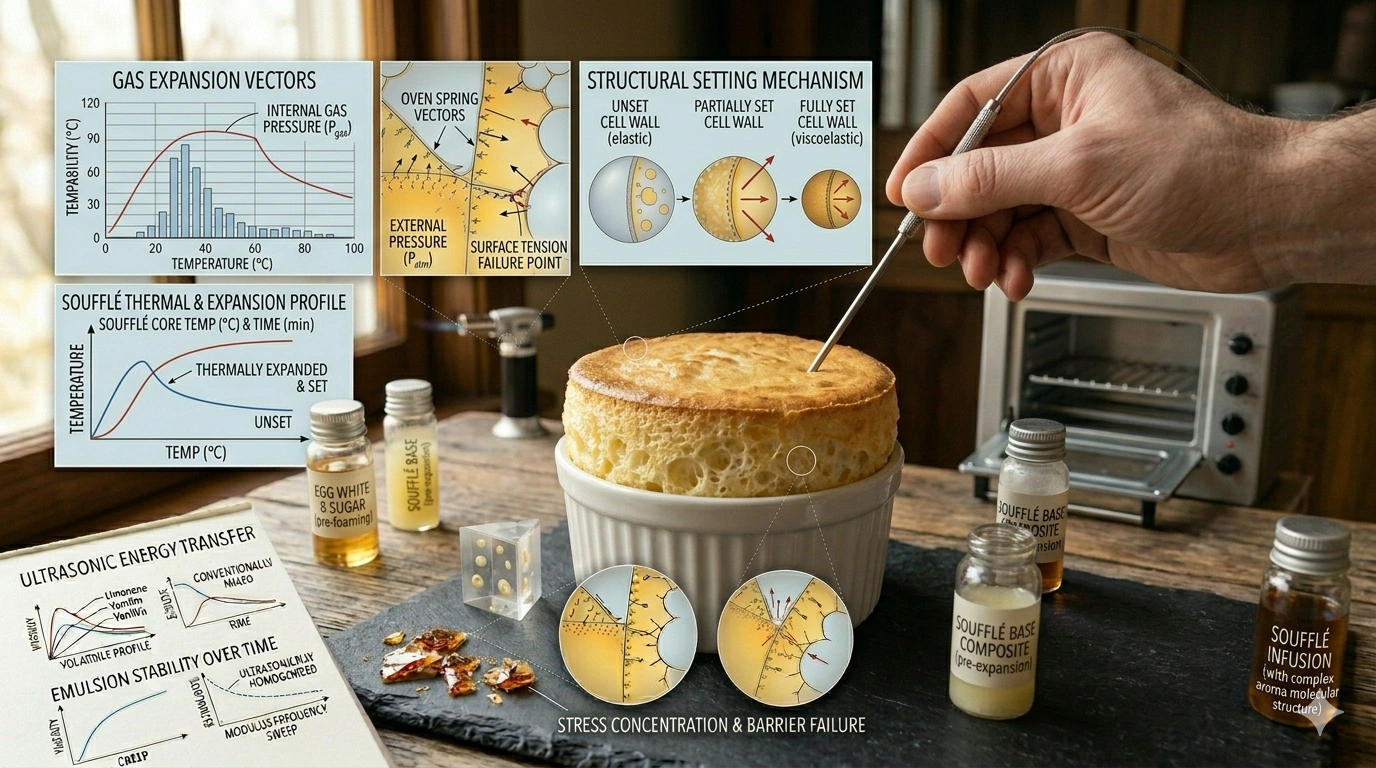
We move from the concentration of aromatics to the dynamic architecture of the Soufflé. Often regarded as the ultimate test of a chef’s timing, the soufflé is a study in gas law thermodynamics and protein network stabilization. It is a temporary structure—a hot, flavored foam that relies on the rapid expansion of air to achieve height and the coagulation of egg proteins to maintain its “walls” against the pull of gravity.
To master the Soufflé, one must understand the relationship between Charles’s Law and bubble-wall elasticity.
Part 1: The Gas Engine – Charles’s Law in Action
The “rise” of a soufflé is driven primarily by the expansion of air trapped within the egg-white foam.
- Thermal Expansion: According to Charles’s Law, the volume of a gas is directly proportional to its absolute temperature ($V \propto T$). As the cool air bubbles inside the batter are heated in the oven, they expand rapidly.
- Vapor Pressure: Simultaneously, moisture in the base (the Panada or pastry cream) turns into steam. This steam provides additional internal pressure, inflating the protein matrix from within.
Part 2: The Structural Frame – The Albumin Matrix
If the gas is the engine, the egg whites are the chassis. The success of the dish depends on the quality of the foam.
- Denaturation and Entrapment: When egg whites are whisked, the globulin and albumin proteins denature and bond together, creating a physical net that traps air bubbles.
- Elasticity vs. Brittleness: If the whites are over-whisked (becoming “dry”), the protein net becomes too brittle. When the gas expands in the oven, the brittle walls snap, causing the bubbles to merge and the soufflé to collapse or “blow out.” A perfect foam must be flexible enough to stretch as the gas expands.
Part 3: The Setting Phase – Coagulation vs. Collapse
A soufflé is a race against time. The goal is for the “walls” of the bubbles to solidify before the gas inside begins to cool.
- The Critical Threshold: As the internal temperature reaches approximately $70^{\circ}C$ to $75^{\circ}C$, the egg proteins undergo coagulation. They transform from a liquid-phase foam into a solid-phase gel.
- The Temporary Nature: Once removed from the oven, the gas inside the soufflé begins to cool immediately. According to the same laws of physics, the volume decreases as the temperature drops. If the protein walls haven’t set firmly enough, the structure will succumb to atmospheric pressure and collapse—the “deflated” soufflé.
Conclusion: The Engineering of Air
The Soufflé proves that heat is a structural tool. By leveraging the predictable expansion of gases and the thermal setting of protein networks, the chef creates a dish that is literally a monument to physics. It is the art of the “Solidified Cloud”—a masterpiece that exists only in a narrow thermal window.