
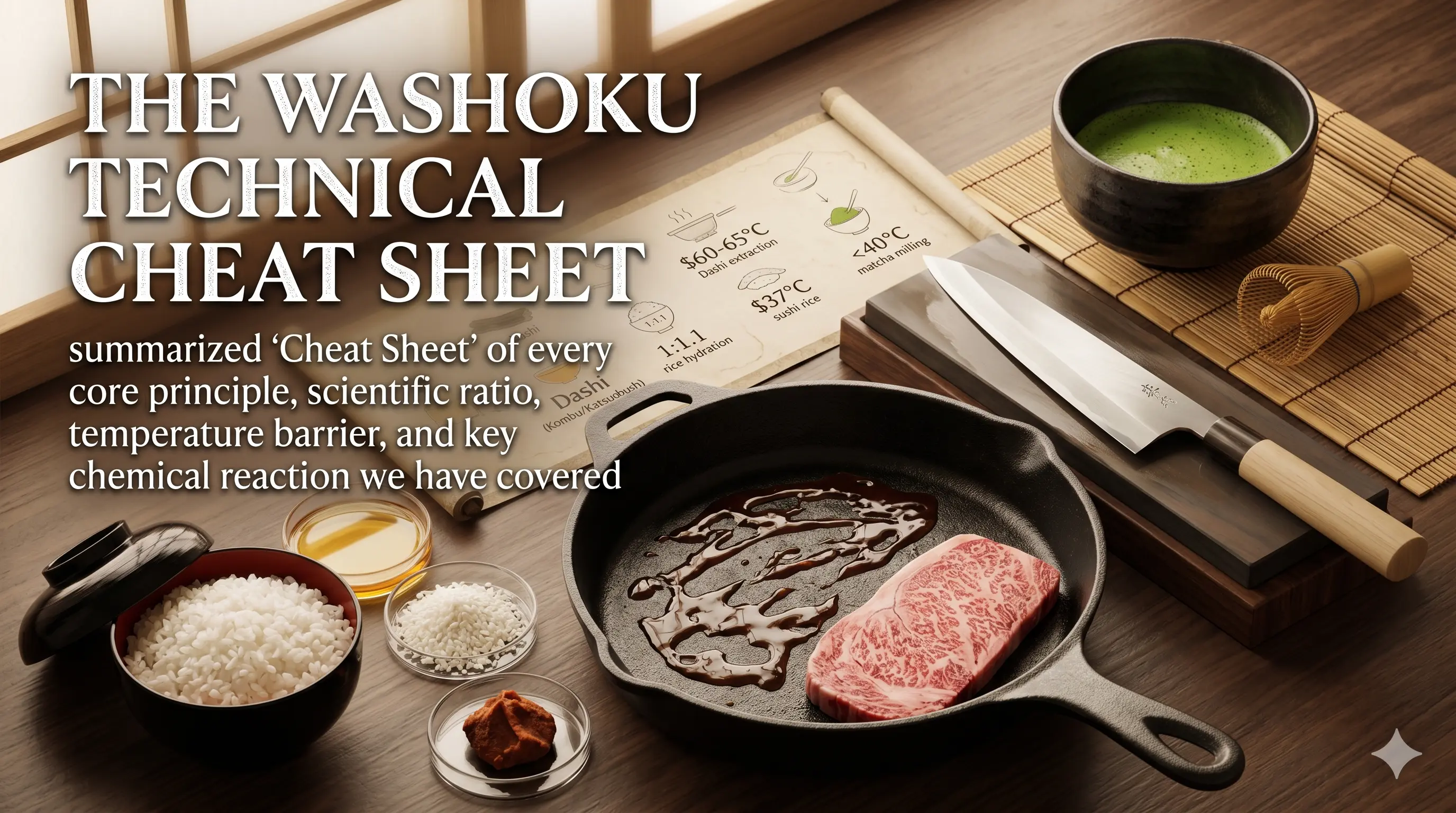
Congratulations! You have completed the 25-part masterclass in Japanese culinary science. From the geometry of the rinse to the forced emulsion of the broth, you now have the conceptual framework to analyze and execute Washoku as a master craftsman does.
However, mastery is not just about understanding; it is about memory. To solidify these concepts, we conclude this journey with the ultimate technical resource: a summarized “Cheat Sheet” of every core principle, scientific ratio, temperature barrier, and key chemical reaction we have covered. This is the condensed molecular language of the Japanese kitchen.
1. Starch and Gohan: Engineering the Foundation (Article 13)
The Starch Geometry
- The Problem: Bran dust (nuka) makes rice gummy and “muddy.”
- The Technical Togi: Dry friction before water. Polishing the grains against each other is the goal.
- The First Rinse: First water must be instantly discarded to prevent absorption of the muddy flavor.
The Hydration and Cook
- The Chemical Soak (Jukusei): 30–60 mins in cold water is mandatory. It ensures even gelatinization and removes the “chalky” core. Translucent becomes opaque white.
- The Absorption Ratio: 1:1.1 (rice:water).
- The Temperature Progression: Boil (Medium Heat), then immediately Low Heat simmer (12–13 mins).
- The “No-Lift” Rule: Lifting the lid breaks the precise steam pressure required for amylopectin conversion.
The Post-Cook
- The Residual Rest (Mushi): 10 mins (lid sealed) to equalize moisture.
- Shari-Kiri (Slicing the Starch): “Cut and fold” motion introducing oxygen and allowing flash-evaporation. Never mash, which activates gluten.
2. Umami Chemistry: Mastering Synergism (Article 14)
The Glutamate Window
- The Source: Kombu (giant kelp) has the highest concentration.
- The Technical Extraction: Cold soak 6–12 hrs is best. If heating, stay strictly between $60^{\circ}C$ and $65^{\circ}C$.
- The Failure Point: $100^{\circ}C$ (Boiling) releases mucilaginous starches and bitter ocean smells, destroying the flavor profile.
The Synergistic Boost
- The Multiplier: Umami synergy (1+1=8) occurs when combining Glutamate with Nucleotides.
- Inosinate (Katsuobushi): The “key” for fish-based nucleotides.
- Guanylate (Shiitake): The “key” for fungi-based nucleotides.
- Awase Dashi: Combining Kombu (Glutamate) with Katsuobushi (Inosinate) forms a molecular lock that maximizes flavor.
3. Sushi: A Study in Acid and Physics (Article 15)
The Shari Science
- The Acid Shift: Biological fermentation (lactic acid) evolved into chemical acidification (acetic acid/vinegar).
- The Thermal Fold: Folding vinegar into steaming hot rice permits core penetration of the acetic acid.
- The Optical Polish: VIGOROUS fanning (Uchiwa) during the fold creates a rapid temperature drop and a “sugar-glass” coating, yielding the magnificent “pearly” sheen.
- The Service Temperature: $37^{\circ}C$ (Human Body Temp). This melts the fish fats slightly upon contact, forming an instant emulsion.
The Nigiri Physics
- The Air Pocket: Nigiri is an engineered collapse. The chef presses the rice vertically to create a shell around a central hollow air pocket.
- The Mouthfeel: Saliva fills the air gaps instantly, allowing the individual rice grains to scatter, maximizing surface area for flavor release.
4. Knife Geometry: Kataba Metallurgy (Article 16)
The Kataba Advantage
- Single Bevel (Kataba): Grind on one side only ($15^{\circ}$ acute angle). Western is double-bevel ($50/50$).
- The Optical Shearing: The single-bevel shears through cellular walls so cleanly that they reflect light, giving the food a magnificent, waxy luster (Tsuya).
- The Urasuki (Concave Back): Creates an air pocket, providing zero-friction drag when slicing starchy or wet materials.
The Specialized Triad
- The Deba: Heavy, obtuse wedge geometry (filleting/bone chopping).
- The Usuba: Thin, rectangular shearing plane (vegetable sheeting).
- The Yanagiba: Long, single-pull shearing sword (sashimi). The pull avoids friction and microscopic tears that lead to flavor leakage.
5. Knife Techniques: The Choreography of Precision (Article 17)
Katsuramuki (Rotary Shearing)
- The Mechanics: Usuba knife. Left thumb (Daikon) fulcrum, right hand shaving. Shearing the cellular walls, not “peeling.” The optical result is reading-thin translucence and waxy luster.
Usu-zukuri (Paper-Thin Sashimi)
- The Mechanics: Yanagiba knife. Acute angle, single-pull shear. Preservation of glutamates by avoiding microscopic tears and “sawing.” Translucent plating.
Sengiri (High-Precision Shred)
- The Mechanics: Knuckle guide, “push-cut” motion. Introduces air pockets between curled vegetable strips, enhancing dressing absorption and mouthfeel.
6. Matcha: The Colloidal Science (Article 18)
Shade-Grown Chemistry
- The Scaffolding (Tana): Shading (up to 90%) forces the plant into chlorophyll stress, yielding electric-green color.
- The Umami Switch: Shading prevents the conversion of sweet L-theanine into bitter catechin.
Microscopic Engineering
- The Milling (Koji): Slow (40–60 RPM) stone-milling.
- The Temperature Barrier: Friction heat must stay $<40^{\circ}C$. Heat above $40^{\circ}C$ oxidizes L-theanine instantly, yielding bitter cooked flavor.
- Particle Size: 5–10 microns (Technical colloidal suspension).
The Suspension Suspension
- Colloidal Suspension: Solid tea particles (microns) suspended, not dissolved, in liquid.
- The Chasen (Whisk): violent, M-shaped/W-shaped rapid vibration, not stirring. The tines act as microscopic shearing planes to force water encapsulation of hydrophobic tea particles.
- Water Management: Must use soft water. Hard water minerals suppress umami and collapse foam. Stay between $70^{\circ}C$ and $75^{\circ}C$. Never boil (tannin release).
7. Tempura: The Steam-Fry Physics (Article 19)
The Cold Batter Barrier
- Preventing Gluten: Ice-cold water is required to slow wheat protein activity and inhibit gluten chains.
- The Lumpy Mix: Over-mixing activates gluten. under-mixing (lumps) ensures a light, flaky texture.
- The Oil: Taihaku (white) sesame oil. High smoke point and neutral flavor to enhance, not overpower, the ingredient.
High-Heat Steaming
- The Micro-Explosion: Ice-cold water vaporizes instantly at $180^{\circ}C$. Expanding steam molecules create millions of microscopic “tunnels” in the porous batter shell.
- Porous Shell: The tunnels prevent the oil from penetrating. The ingredient is actually cooked by internal internal water—steamed inside the shell.
8. Takoyaki: The Street-Engineering Geometry (Article 20)
The Molten Core
- The Custard Rheology: Takoyaki is a custard, not a dough. A 4:1 to 5:1 Dashi-to-flour ratio (highly-hydrated batter).
- The Soy/Egg Factor: Soy provides browning (Maillard), while egg proteins stabilize the molten gel interior.
- Tenkasu Structure: Internal “structural supports” and oil sponges to fry the interior from the inside out.
The Wan-ga-shi Technique
- The Geometry: Hemispherical indentations in heavy cast iron.
- Tuck and Roll: “Flood and tuck” surround batter for a thick, structural wall.
- Hollow-Core Effect: repetitive 90° and 180° rotation pushes the internal batter to the hot walls, creating a hollow-core with fried exterior and steaming, velvety core.
9. Miso: The Biological Engine (Article 21)
The Koji Catalyst
- Protease Factory: Koji mold (Aspergillus oryzae) releases protease and amylase.
- Biological Demolition: Protease breaks soy proteins into free amino acids (Glutamates), while amylase breaks rice starches into simple sugars.
The Miso Spectrum
- Shiro (White): Low salt, short fermentation. stopped early for high sugar content. creamy, sweet.
- Aka (Red): High soy/salt, long fermentation (1–3 years). maillard reaction turns paste deep red/brown. complex, salty, intensely umami.
The Kitchen Rule
- The No-Boil Rule: Whisk into soup off the heat. never boil ($<90^{\circ}C$). boiling kills enzymes and vaporizes delicate aroma compounds.
10. Unagi: The Perpetual Tare (Article 22)
Fat Management (Kabayaki)
- Kiri (Slice): Specialized Unagi-saki knife. Butterflied while alive to integrate fat/muscle.
- Mushi (Steam): Dissolves collagen/renders heavy fat (soft “melt-in-mouth” texture).
- Yaki (Sear): Binchotan charcoal. High infrared heat caramelizes glaze. Dripping fat creates complex smoke aromatics.
Infinite Tare
- Perpetual Replenishment: daily soy/mirin/sugar addition. vat base remains decades-old concentrated emulsion of thousands of individual eel fats and juices.
- Safety: high sugar/salt and daily flash-pasteurization from searing hot eels maintain biological stability.
Chemical Palate Cleansing
- Sansho Pepper: contains hydroxy-alpha-sanshool. creates tingle/vibration. cuts rich fat, maximizing Tare nuance until the final bite.
11. Sukiyaki and Shabu-Shabu: Opposing Geometries (Article 23)
Sukiyaki (大阪スタイル)
- The Braise: wide, heavy cast-iron skillet (caramelization focus).
- Maillard Focus: Sear meat/fat suet FIRST on iron. apply Warishita reduction LATER. results in deep, sweet-savory braised depth and magnificent, sticky-caramelized sheen.
- The Egg Dip: Raw egg yolk buffer cuts extreme sugar/salt intensity (aromatic buffering). piped-hot beef ($90^{\circ}C+$) “flashes” the cold egg, pasteurizing the coating (biological safety).
Shabu-Shabu (Flash-Steaming)
- The Geometry: Vortex pot (Donabe) with central conical chimney creates powerful internal convection, stabilizing rolling boil ($100^{\circ}C$).
- The “Swish-Swish”: thin Wagyu slice swished into boiling vortex (3–5 seconds). flash-cook instant-renders surface fat (creamy emulsion) while keeping internal structure rare (ultimate marbling flavor compromise).
12. Japanese Curry: Re-Engineering the Roux (Article 24)
The Dark Roux
- Technical Saucier Technique: butter-flour emulsion. prolonged cook ($140^{\circ}C$ for 45 mins) creates dark, chocolatey color (dark roux).
- Molecular Maillard: toasty/nutty compounds. heavily-cooked flour loses thickening power but gains immense flavor. stable emulsion is thick/velvety without feeling “starchy.”
Enzyme-Driven Sweetness
- Enzymatic Breakdown: natural fruit acids (Aomori apples malic acid) and onion jam provide backbone sweetness. fruit acids act as beef tenderizer during long simmer.
The Day-Two Rest (Ichiban-ne)
- Aging: 24-hour cooling period. Cold temperatures allow starch retrogradation to settle, resulting in cohesive sauce with “rounder” flavor profile.
13. Ramen: The Final Emulsion (Article 25)
Tonkotsu (Paitan) – Cloudy
- Forced Emulsion: high-energy rolling boil (12–18 hours). kinetic energy breaks bone marrow fat into microscopic droplets. gelatin from collagen coats fat droplets, forming stable, creamy, opaque white soup with high-viscosity.
Shoyu/Shio (Chintan) – Clear
- The Sub-Simmer: strict temperature $80^{\circ}C$ to $90^{\circ}C$. no kinetic agitation. denatured proteins scavenge/trap impurities (biological filter), resulting in optically transparent liquid.
- Separation: fat (Aroma Oil) added separately at end as distinct, shimmering “jewels.”
Kansui Chemistry (The Noodle)
- Alkaline Shift: potassium/sodium carbonate (pH shift). inhibits wheat softening enzymes. creates specific “springy” chew (Koshi) and yellowish hue.
Conclusion: The Final Master’s Hand
This concludes our entire journey. You have analyzed the chemical structures of umami, the fluid dynamics of a rolling boil, and the precise angles of a single-bevel knife. You now possess the scientific and conceptual tools to view every Japanese dish not as a recipe, but as a technical assembly of ratios, geometry, and phase changes. Respect the temperature, trust the ratio, and protect the enzyme. The technical mastery of Washoku is now in your hands.