
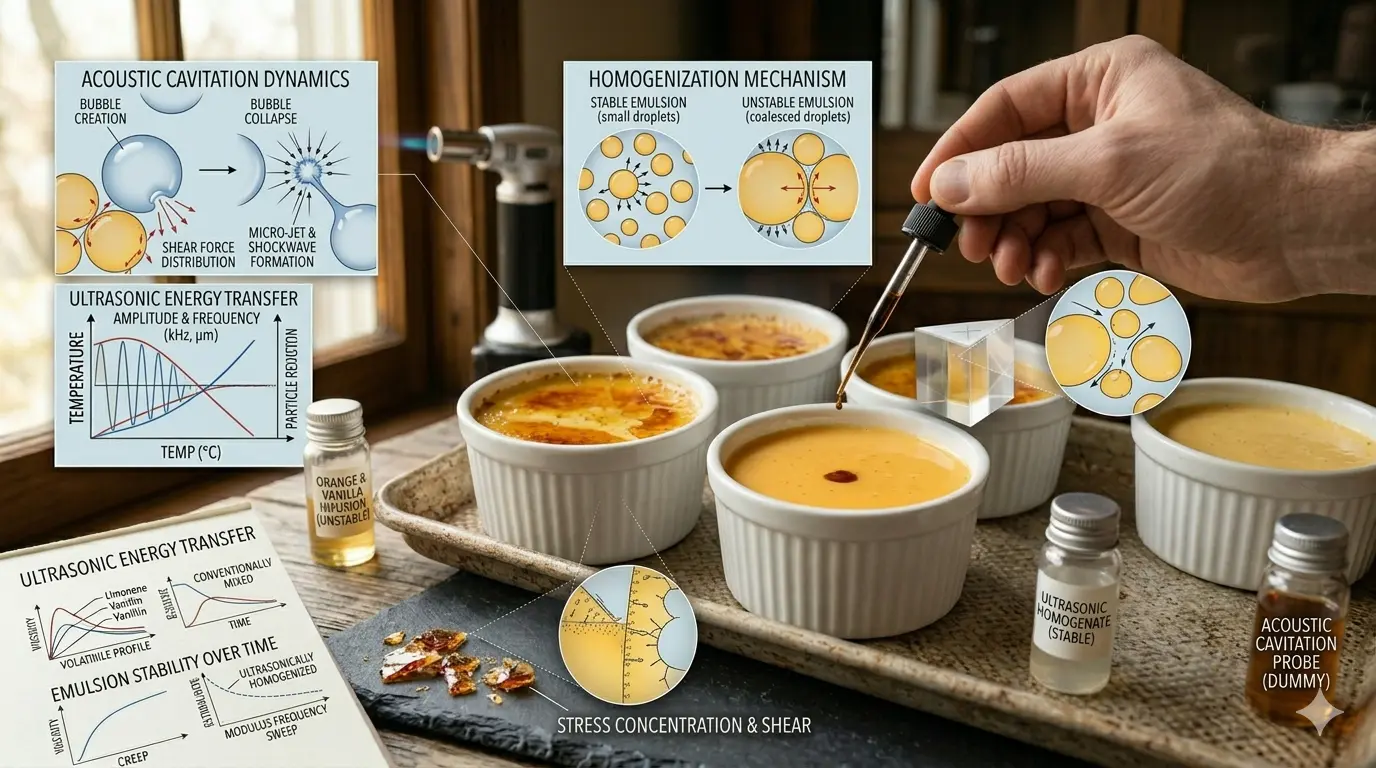
We move from the slow fermentation of bread to the instantaneous, high-energy world of Sonic Engineering. In the modern “lab-kitchen,” the Ultrasonic Homogenizer (or Sonicator) is used to create emulsions and infusions that are physically impossible with mechanical blending. By using high-frequency sound waves ($20$ kHz+), a chef can force fat and water into a permanent bond without the need for traditional emulsifiers like mustard or egg yolks.
To master Ultrasonic Homogenization, one must understand the relationship between acoustic energy and cavitation-induced shear.
Part 1: Acoustic Cavitation – The Power of the Void
The core mechanism of the sonicator is not the sound itself, but the creation and collapse of microscopic bubbles, a process known as cavitation.
- Pressure Cycles: The titanium probe (the horn) vibrates at ultrasonic speeds, creating alternating cycles of high and low pressure in the liquid.
- The Micro-Implosion: During the low-pressure cycle, thousands of microscopic vacuum bubbles form. During the high-pressure cycle, these bubbles implode violently.
- Localized Extremes: At the point of implosion, localized temperatures can reach thousands of degrees and pressures can exceed $1,000$ atmospheres. This happens in nanoseconds at a microscopic scale, so the bulk liquid remains cool, but the mechanical shear is immense.
Part 2: Permanent Emulsions – Beyond the Micelle
In traditional whisking, fat droplets are broken down to a certain size. In ultrasonic homogenization, the cavitation forces shatter fat globules into sub-micron sizes.
- Brownian Motion Dominance: Because the fat droplets are so small, the natural molecular “jiggling” known as Brownian Motion becomes stronger than the force of gravity. The droplets stay suspended indefinitely because they are too small to float to the top.
- The “Naked” Emulsion: This allows for the creation of stable emulsions using only oil and a flavored liquid (like vinegar or juice). The chef can produce a “mayonnaise” texture using only olive oil and lemon juice, with zero egg yolks, resulting in a flavor profile of incredible purity.
Part 3: Rapid Cold Infusion – Shattering Cell Walls
Beyond emulsions, the sonicator is an elite tool for flavor extraction.
- Cellular Rupture: When a chef places herbs, spices, or even wood chips into a liquid and applies ultrasonic energy, the cavitation bubbles implode against the surface of the solid ingredients.
- Instantaneous Transfer: This acts like a microscopic jackhammer, rupturing the cell walls and forcing the aromatic oils directly into the liquid. A process that traditionally takes weeks (like making a bitters or a flavored spirit) can be completed in less than five minutes at room temperature, preserving the “bright” notes of the fresh ingredient.
Conclusion: The Sound of Flavor
Ultrasonic homogenization proves that energy is an ingredient. By utilizing acoustic cavitation to bypass the limits of mechanical shear, the modern chef can manipulate the very structure of liquids and solids. It is the physics of the “Micro-Blast”—a way to achieve perfect stability and intense extraction through the power of sound.