
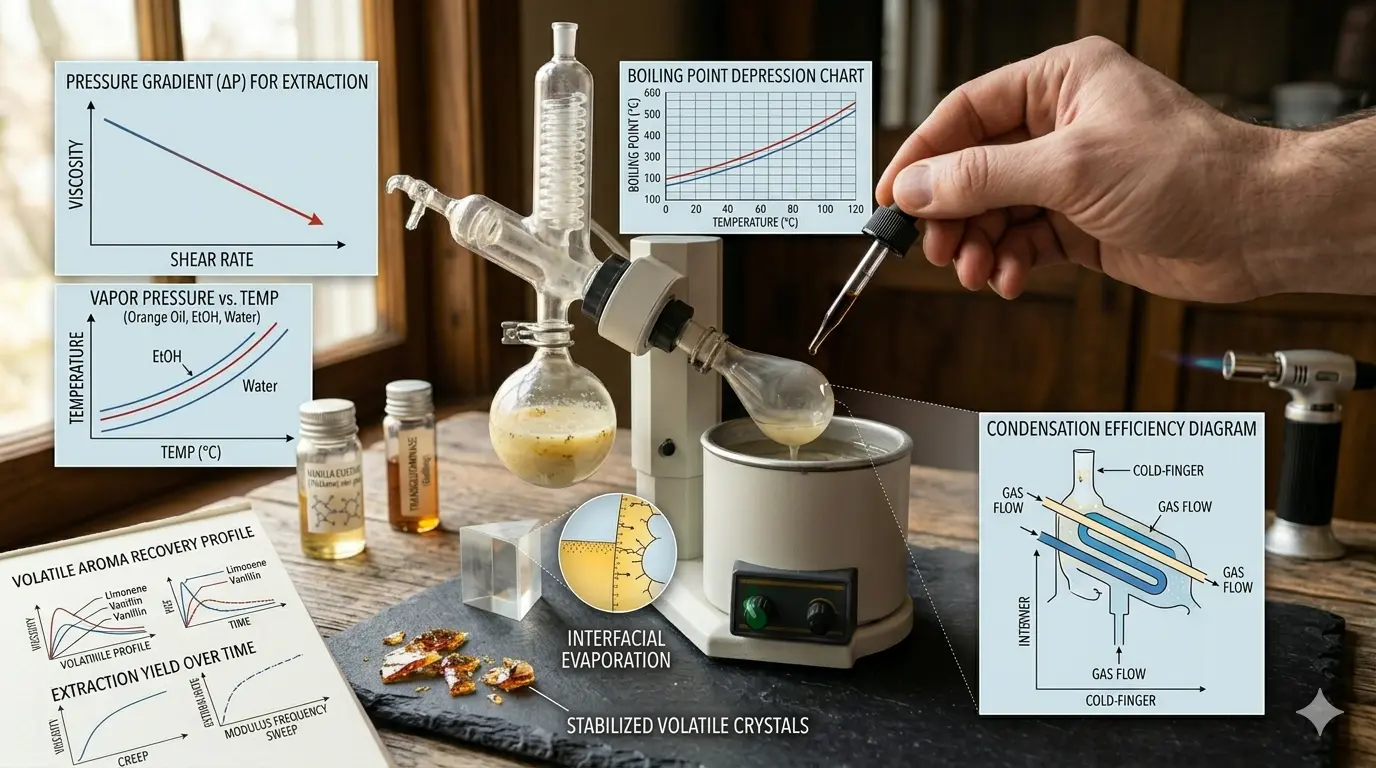
We move from the physical texture of liquids to the molecular capture of scent. In the highest tiers of modern gastronomy, flavor is often separated from mass using a Rotary Evaporator (Rotovap). This technique allows a chef to perform vacuum distillation, boiling off delicate aromatic compounds at room temperature to prevent the thermal degradation (the “cooked” taste) that occurs with traditional reduction.
To master vacuum extraction, one must understand the relationship between vapor pressure and the boiling point of ethanol and water.
Part 1: The Vacuum Principle – Defying the Boiling Point
The boiling point of any liquid is the temperature at which its vapor pressure equals the surrounding atmospheric pressure.
- Standard Pressure: At sea level ($1$ atm), water boils at $100^{\circ}C$. At this temperature, many delicate aroma molecules (esters and aldehydes) are destroyed or altered.
- Reduced Pressure: By using a vacuum pump to remove air from the system, the Rotovap reduces the internal pressure. In a near-vacuum, water can be made to boil at $25^{\circ}C$ to $30^{\circ}C$.
- The Engineering Objective: This allows the chef to “distill” the essence of fresh herbs, soil, or even delicate flowers without applying heat, capturing a “cold” aroma that is identical to the raw ingredient.
Part 2: The Centrifugal Variable – The Rotating Flask
The “Roto” in Rotovap stands for rotation. This is not just for mixing; it is a critical piece of thermal engineering.
- Surface Area Maximization: As the flask rotates, the liquid forms a thin film across the entire interior surface. This massively increases the surface area available for evaporation.
- Bumping Prevention: In a vacuum, liquids tend to boil violently (called “bumping”). The rotation creates a centrifugal force that keeps the liquid against the walls, ensuring a smooth, controlled transition from liquid to vapor.
Part 3: The Condenser – Capturing the Volatile Phase
Once the flavor molecules have turned into vapor, they must be “caught” and returned to a liquid state.
- The Chilled Coil: The vapor travels into a glass tower containing a coil chilled to $-10^{\circ}C$ or $-20^{\circ}C$. The sudden drop in temperature causes the vapor to condense instantly.
- The Distillate vs. The Residue: * The Distillate: The clear liquid collected in the receiving flask. This contains the pure, concentrated aroma of the source material.
- The Residue: The concentrated solids left in the boiling flask. These often have a deep, “cooked” or syrupy profile.
Conclusion: The Ghost of Flavor
Vacuum extraction proves that the most powerful part of a dish—its scent—can be decoupled from its physical form. By manipulating vapor pressure to bypass thermal destruction, the modern chef can create “clear” flavors of coffee, forest floor, or fresh basil that are physically impossible to achieve through traditional boiling. It is the physics of isolation.