
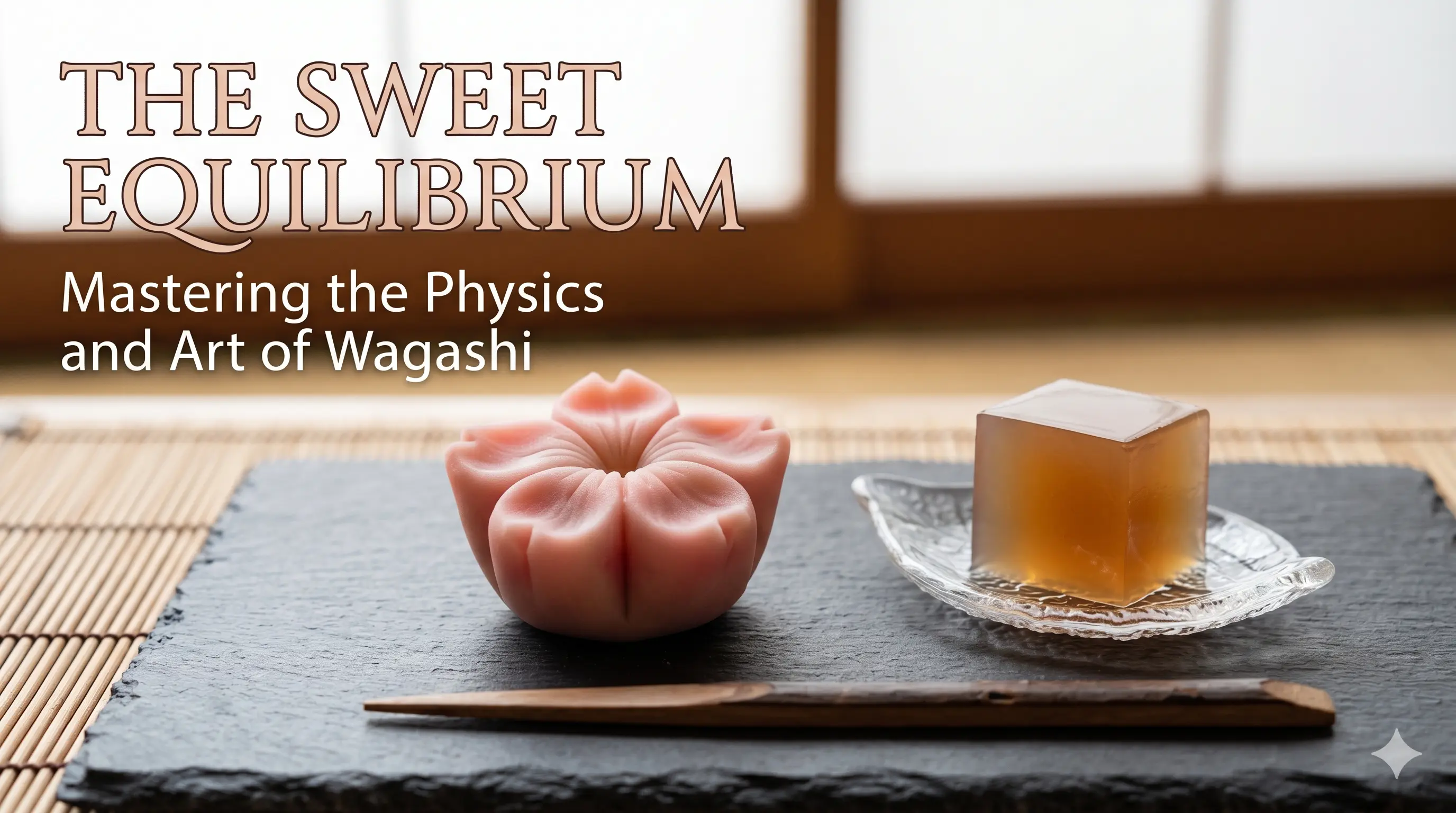
While Western confectionery often relies on the structural properties of dairy fats and eggs, traditional Japanese sweets, or Wagashi, are built on the technical manipulation of plant-based starches and proteins. Specifically, Wagashi is a masterclass in the rheology of Anko (bean paste) and the gelling physics of Agar-agar (Kanten).
These sweets are not merely “desserts”; they are engineered to provide a specific sensory counterpoint to the bitterness of Matcha, requiring precise control over moisture content and crystalline structure.
Part 1: The Chemistry of Anko – Protein and Sugar Saturation
The foundation of most Wagashi is Anko, a paste made from Azuki beans. Unlike a simple puree, Anko is a complex suspension of starch granules encased in bean cell walls.
The Breakdown of the Azuki
- The “Go-zen” vs. “Tsubu” Distinction:
- Tsubu-an: Coarse paste where the bean skins are left intact. This provides a heterogeneous texture and rustic mouthfeel.
- Koshi-an: Fine, passed through a microscopic sieve to remove all skins. This results in a smooth, homogeneous protein-starch gel.
- Sugar as a Structural Element: Sugar in Anko isn’t just for flavor; it’s a humectant. It binds to water molecules, preventing the starch from drying out and ensuring the paste remains pliable enough to be sculpted into the delicate, lifelike shapes seen in Nerikiri.
Part 2: Kanten – The Thermostable Gel
While Western jelly relies on animal-based gelatin, Wagashi uses Kanten (Agar-agar), derived from red algae. The physical properties of Kanten are fundamentally different and more technically demanding.
The Thermal Paradox
- Higher Melting Point: Unlike gelatin, which melts at body temperature ($35^{\circ}C$), Kanten stays solid up to $85^{\circ}C$. This means Wagashi can maintain its sharp, engineered edges even in a humid tea room.
- Syneresis Control: If Kanten is not boiled correctly with the right sugar concentration, it will “weep” water—a process called syneresis. A master must balance the $pH$ and sugar levels to ensure the gel remains crystal clear and holds its internal moisture perfectly.
Part 3: Nerikiri – The Sculptural Engineering
Nerikiri is the pinnacle of Wagashi technique, often shaped into seasonal symbols like cherry blossoms or maple leaves.
- The Mochi-An Hybrid: It is a mixture of Shiro-an (white bean paste) and a small amount of Gyuhi (sweetened glutinous rice flour).
- The Pliability Factor: Adding the rice starch (Gyuhi) introduces elasticity to the crumbly bean paste. This creates a “culinary clay” that can be manipulated with specialized wooden tools without cracking.
- The Sensory Buffer: Because Matcha is high in tannins and acidity, Nerikiri is engineered with high sugar density. When eaten before the tea, the sugar coats the tongue, chemically “buffering” the palate so the tea’s umami and sweetness are highlighted rather than its bitterness.
Conclusion: Engineering the Seasonal Moment
Wagashi is the intersection of botany, chemistry, and sculpture. It demonstrates that with just beans, rice, and seaweed, the Japanese craftsman can engineer a world of textures—from the firm, glass-like clarity of Yokan to the soft, velvet pliability of Nerikiri. It is the final, sweet proof that in Washoku, every ingredient is a tool to be mastered.