
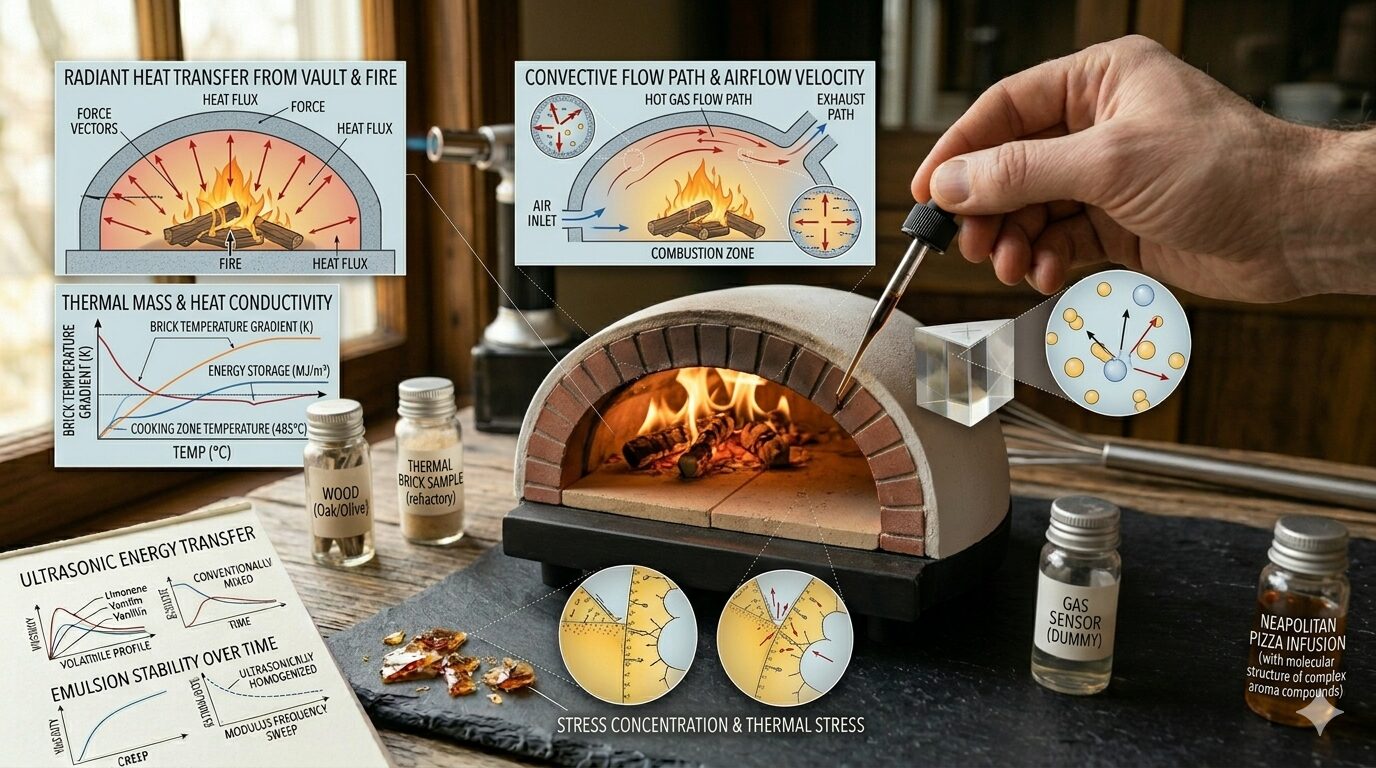
We transition from high-tech sonicators to the ancient, high-heat engineering of the Wood-Fired Oven. A true Neapolitan pizza is not “baked” in the traditional sense; it is subjected to a poly-thermal assault. To achieve the signature “leopard-spotting” (charred blisters) while keeping the interior soft and hydrated, the oven must manage three distinct modes of heat transfer simultaneously within a $60$ to $90$-second window.
To master the Wood-Fired Oven, one must understand the relationship between radiative flux and thermal mass conductivity.
Part 1: The Vault Geometry – Radiative Reflection
The dome shape of a wood-fired oven is not aesthetic; it is a parabolic heat reflector.
- The Flame Curve: As the wood burns on one side of the oven, the flames lick up the curved wall and across the ceiling. This creates a rolling “flame floor” across the top of the vault.
- Radiative Heat: The dome, typically made of high-density refractory brick, absorbs this energy and radiates it back down toward the center of the floor. This blackbody radiation is what cooks the toppings and the top of the crust at temperatures exceeding $480^{\circ}C$ ($900^{\circ}F$).
Part 2: The Floor – Conductive Heat Transfer
While the dome handles the top, the hearth (floor) handles the base through direct contact.
- Specific Heat Capacity: The floor must be made of a material that can hold massive amounts of energy but release it slowly enough not to incinerate the dough instantly. This is why “Biscotto di Casapulla” (a specific clay) is prized; its low thermal conductivity compared to standard firebrick allows the pizza to sit on a $450^{\circ}C$ surface without burning the bottom before the top is finished.
- The Moisture Flash: The moment the dough hits the floor, the bottom-most layer of water flashes into steam, creating a microscopic “cushion” that helps prevent sticking while the crust sets.
Part 3: The Convection Current – The Oxygen Pump
The third pillar of the oven’s physics is the Convective Loop.
- The Thermal Siphon: Cold air is pulled in through the bottom of the oven opening. It travels toward the fire, feeds the combustion, and then—now superheated—rises and sweeps across the dome before exiting through the top of the opening.
- The “Micro-Climate”: This constant movement of hot air ensures that moisture evaporating from the pizza is swept away, allowing the crust to crisp quickly despite the extremely short cooking time.
Conclusion: The Equilibrium of the Flame
The Wood-Fired Oven proves that extreme heat requires extreme control. By balancing the radiative power of the dome, the conductive capacity of the floor, and the convective flow of the air, the baker engineers a environment that can transform raw dough into a charred, airy masterpiece in less than two minutes. It is the physics of the “High-Heat Flash.”