
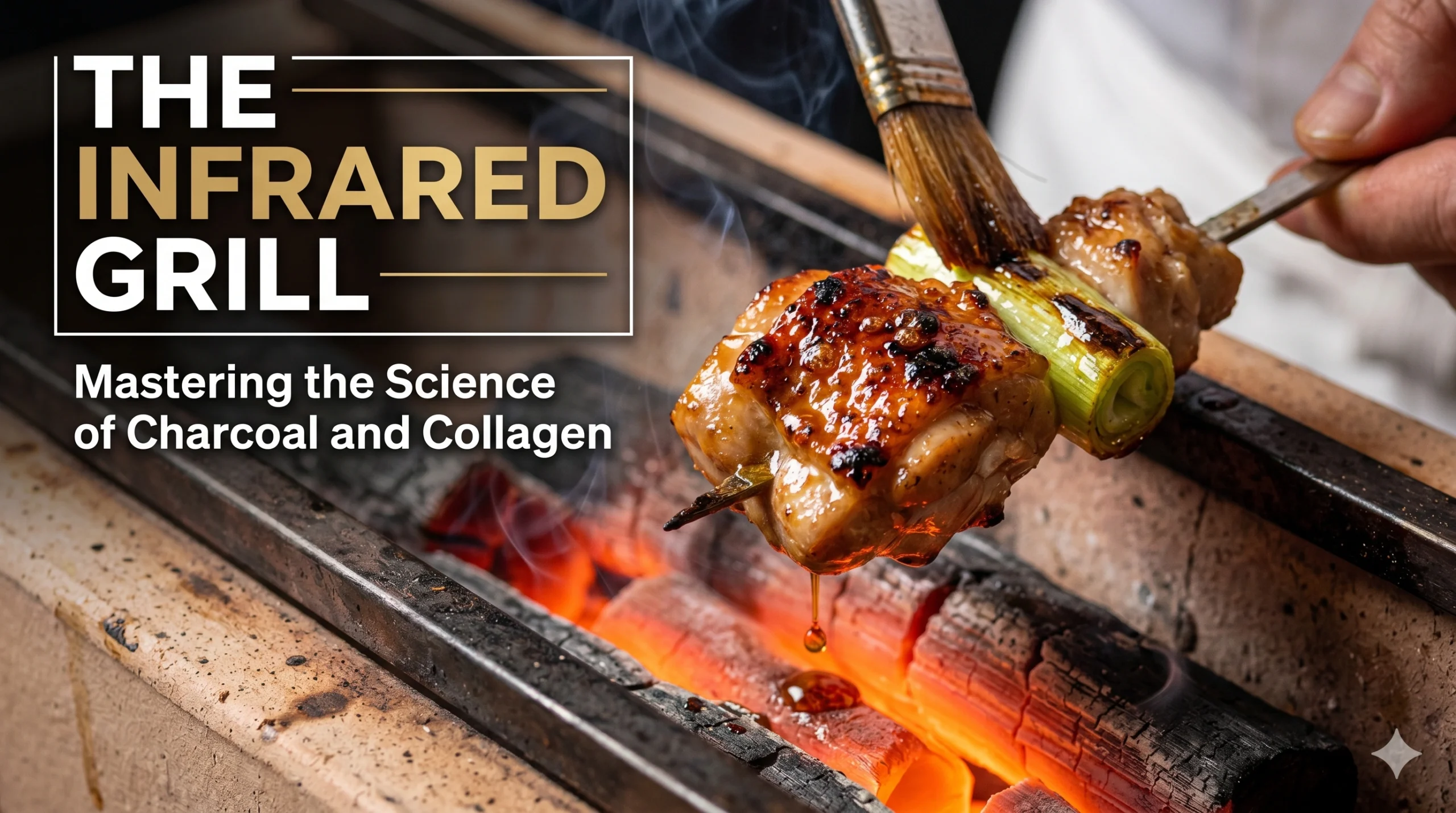
While often categorized as “street food,” Yakitori (grilled chicken skewers) is technically a sophisticated form of high-temperature engineering. It is not a matter of simply “barbecuing”; it is a study in infrared thermal transfer, cellular collagen denaturation, and the control of fat polymerization. A professional Yakitori chef (Yakitori-ya) manipulates these variables to achieve a crispy, Maillard-rich exterior while maintaining an almost molten, succulent interior.
To master Yakitori, one must move beyond the concept of “grilling” and toward the management of infrared radiation and moisture activity ($a_w$).
Part 1: Binchotan – The Ultimate Infrared Tool
The primary engineering tool of Yakitori is not the chicken; it is the Binchotan charcoal (Japanese white charcoal). Unlike Western briquettes, which generate heat through convection (hot air), Binchotan operates almost entirely through Far-Infrared Radiation (FIR).
The Physics of FIR
- The High-Energy Transfer: Far-Infrared Radiation has a shorter wavelength and higher energy than the near-infrared heat generated by lesser charcoal or gas. When FIR hits the cellular structure of the chicken, it doesn’t just heat the surface; it penetrates the protein layers deeply, cooking the meat uniformly from the inside out.
- The No-Flare Zone: Binchotan burns extremely hot (over $1000^{\circ}C$). Crucially, it burns cleanly and with virtually no smoke. Why? Because the charcoal itself has been carbonized at such extreme temperatures, it lacks the volatile compounds that cause lesser coals to smoke and flare when chicken fat drips onto them.
Part 2: Cellular Denaturation – Managing the “Pop”
The goal of Yakitori is to transform tough connective tissue into succulent gelatin without drying out the muscle fiber.
The Collagen Threshold
- The “Toughness” Crisis: Chicken, especially parts like the thigh (Momo) or skin (Kawa), is rich in collagen. Collagen is a triple-helix protein that is incredibly tough and rubbery.
- The Thermal Window: To make the meat tender, this collagen must be denatured (unraveled) and hydrolyzed into silky gelatin. This physical phase change occurs precisely between $60^{\circ}C$ and $70^{\circ}C$.
- The Timing Trap: If the chef keeps the meat in this window too long, the muscle proteins (myosin/actin) also denature completely, squeezing out all the internal moisture (Water Activity). The FIR of the Binchotan is the solution. The high-energy radiation flashes the exterior to create the Maillard reaction (browning and flavor), while deeply and rapidly heating the interior to cross the $60^{\circ}C$ collagen threshold instantly, trapping the remaining juices before they can evaporate.
Part 3: The Garnish as a Thermal Tool (Negima)
A prime example of dynamic engineering in Yakitori is Negima—skewers alternating chicken thigh and Negi (Japanese long onion). The onion is not just for flavor; it is a critical component of moisture and fat management.
- The Vapor Barrier: As the chicken cooks, its internal water turns to steam. The porous structure of the Negi onion absorbs this steam, hydrating itself while simultaneously providing a humid vapor barrier around the chicken. This slows down moisture loss from the meat.
- Fat Emulsification: The sulfur compounds and natural sugars in the Negi chemically interact with the hot chicken fat, emulsifying it slightly. This prevents the fat from becoming greasy and instead transforms it into a rich, savory glaze that adheres to the skewer.
Conclusion: The Final Glaze
Yakitori is the precise application of intense infrared physics. By utilizing Binchotan to achieve deep cellular heating, the master chef managed the precise denaturation of collagen, transforming a standard skewer into a complex, gelatin-rich masterpiece of texture and flavor. It is proof that even over a charcoal fire, the technical precision of Washoku remains absolute.